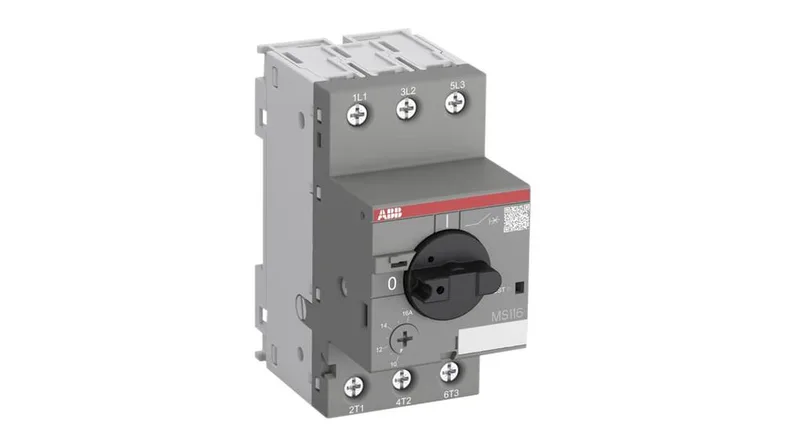
It is a 3-pole device, 45 mm wide, 90 mm tall, and 85.6 mm deep, so the DIN-rail footprint matches the standard 45 mm modular slice used across this ABB accessory family and lines up cleanly under a same-frame contactor. In a typical motor-starter assembly, this part takes the place of a fuse + overload combination: it carries the motor load itself, interrupts short-circuit fault current, and provides the adjustable thermal trip element that protects the windings — the contactor handles the switching duty downstream.
Ratings that actually decide the fit
Sizing must be done against the motor's full-load current on the nameplate, not against the 6.3 A label. Derating per the thermal characteristic sheet still applies above 70 °C.
Footprint, ingress, and wiring
Width 45 mm keeps it on the standard modular pitch; depth 85.6 mm drives the cabinet depth allowance behind the DIN rail — leave room for the same-frame contactor that clips on the load side of the device. Protection rating is IP 20 on the operator side and IP 10 at the terminations, so the front face is finger-safe during normal operation but the wiring side still needs a closed enclosure or shroud before live work. Flexible conductor range is 0.75 mm² minimum to 2.5 mm² maximum. Ferruled ends are recommended at the upper end of the range to keep the cage clamp seated under vibration.