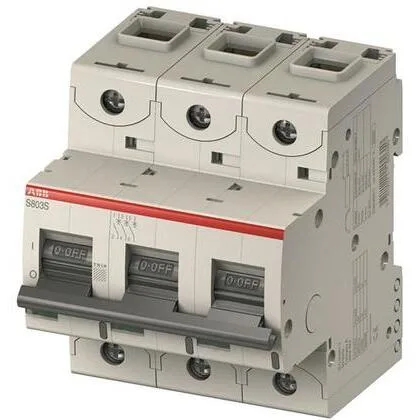
The 125 A rating means it carries continuous loads up to that level without nuisance tripping, sized for high-current branch circuits feeding motor loads, welding equipment, or transformer primaries. Curve D provides a magnetic trip threshold of 10–20× In (1,250–2,500 A instantaneous), so it tolerates the inrush of heavy inductive loads without tripping on start-up — the right curve for motor feeders and drives where a B or C curve would nuisance-trip on energization.
Deployment context
Snap-on DIN rail mounting means it clips directly into a standard 35 mm top-hat rail in the distribution board or control panel. The 3-pole footprint occupies three modular units (3 × 17.5 mm) — plan your rail fill accordingly, and leave the required air gap between adjacent breakers for thermal derating if the load approaches 125 A continuously.
The S803C-D125 carries a current lifecycle stage — it remains in ABB's active S800C portfolio, so it is not subject to phase-out or last-time-buy constraints.
The closest sibling in the same S800 family is the S803S-D63, which shares the same 3-pole D-curve architecture and DIN-rail footprint but at 63 A with a 50 kA interrupting capacity. The S803C-D125 trades a lower 15 kA interrupting rating for a higher 125 A continuous rating — so if your fault current at the panel exceeds 15 kA, step up to the S803S frame. If your load is under 63 A and you need the extra fault-clearing headroom, the S803S-D63 is the better fit. Both drop into the same rail and busbar layout without rewiring.