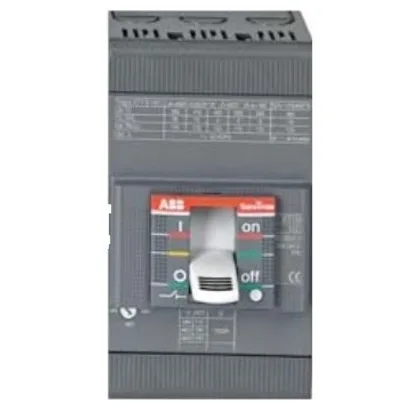
The three-pole, front-front terminal configuration makes it a direct fit for UL/CSA panelboards and distribution switchgear where the breaker is fed from the line side and the load connects to the front lugs — no rear-connection adapter needed.
The TMF 30-500 designation means the thermal element is adjustable from 30 A to 500 A (set via a dial on the trip unit face), while the magnetic pickup is fixed — typically around 10× the rated current for a TMF curve. That spread covers everything from a small 30 A feeder to a 500 A motor circuit, but the 125 A frame limits the continuous current rating to 125 A regardless of the trip setting. If the load draws more than 125 A continuously, step up to a larger frame. The UL/CSA listing tells you it meets the short-circuit current ratings required for North American panelboard coordination studies.
Termination and panel integration
Front-front (F F) terminals mean both line and load connections are on the front face of the breaker — no rear studs or plug-in base. This simplifies bus-bar layout in a distribution panel: the breaker bolts directly to the bus on the line side, and the load conductors land on the front lugs. Standard tunnel-type terminals accept copper or aluminum conductors. The XT1S frame width is 105 mm per pole, so a three-pole unit occupies roughly 105 mm of panel width. Mounting is via the integral bolt-on base; no DIN rail adapter is used for this UL/CSA variant.