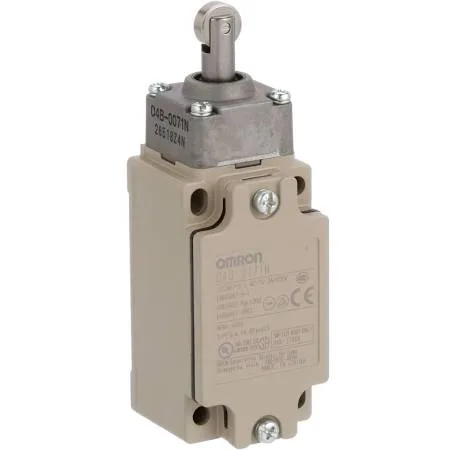
Mature production, still specified
The D4B1171N: The Omron D4B-1171N sits in the manufacturer's mature lifecycle stage, which for a panel-spec reader means the part remains on the BOM line but is no longer a growth SKU — quoting is straightforward, new design-ins are uncommon, and the supply posture is one of holding the existing installed base rather than chasing new sockets. It carries the Omron brand through its industrial automation line and is catalogued as a roller-plunger limit switch with a DPDT/SPDT contact block.
What the contact block actually does
Two contacts arranged in DPDT/SPDT throw give the installer a maintained-form-C plus a Form-A-style pair from a single actuator, which is the common pattern on safety-chain and indicator-coil wiring where one pole feeds the safety relay and the other drops the auxiliary. The action is On-Mom, so the contacts transfer the moment the plunger passes the operating point — no maintained latch, no manual reset. Rated 10 A switching current at 120 V supply — the headline figure that decides whether this switch can directly break an inductive load like a contactor coil or motor contactor aux circuit. The 500,000-cycle electrical life puts the part firmly in heavy-duty industrial territory rather than light-duty detection; on a conveyor or guard-door application cycled a few times per shift, the unit is sized to outlast the machine's first overhaul.
Actuation feel and switch travel
Pretravel is 2.032 mm with a differential travel of 1.016 mm — meaning the contacts transfer, then must back off by roughly that distance before resetting. That differential is the value to check against a cam profile: too tight and the switch chatters on a worn actuator, too loose and the machine trips late. Operating force is 18.63 N and the operating position is 1.89 inch from the reference face. Overtravel allowance is 5.0038 mm past the operating point — this is the margin an installer has to push the plunger past trip without damaging the internal mechanism, which matters when a guard-door is over-traveled by a stiff mechanical linkage or a worn cam lobe.
Thermal envelope, termination, and panel fit
Operating temperature spans -40 °C to 80 °C, so the switch sits comfortably in an unheated cabinet in a cold-storage yard or on the exterior skin of a foundry conveyor without derating. Termination is screw-type, which is the conventional choice when the field side is wired with ring or fork lugs on a maintenance-friendly panel — no crimp tooling required at swap-out.
Where this switch goes in the panel
Roller-plunger limit switches of this class are most commonly deployed on conveyor guard doors, machine-tool slide position checks, and packaging-line end-of-travel stops — anywhere a moving element needs to confirm a safe-state or a process endpoint to a safety relay, contactor coil, or PLC discrete input. The DPDT contact count covers both the safety chain and an indicator lamp or auxiliary contactor from a single actuator.
Procurement posture and traceability
Because the part sits in the manufacturer's mature lifecycle stage rather than active growth, the procurement decision is one of holding the BOM line, not chasing design wins. No price, stock count, or lead-time number is asserted on the page; availability is confirmed at the RFQ stage.