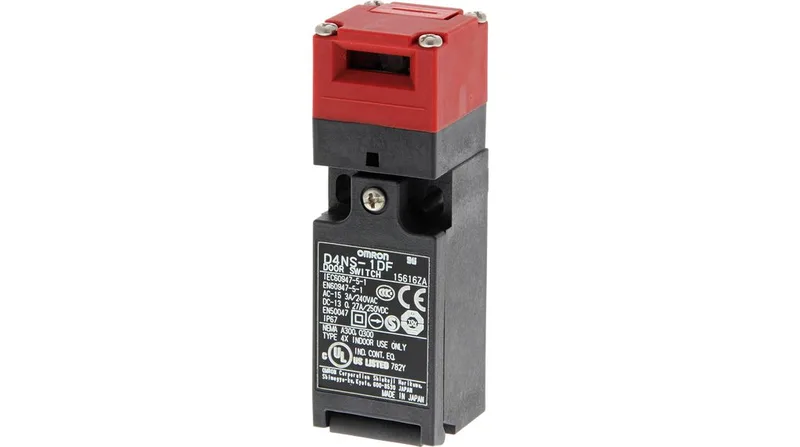
What the 3NC contacts and IP67 rating mean for a safety circuit
The D4NS2DF is Omron's D4NS-series compact safety interlock switch — the 3NC contact configuration is the defining safety characteristic here. All three contacts are normally-closed when the guard is open, and they open (breaking the safety circuit) as soon as the actuator is withdrawn. Power must be applied to hold the circuit closed — a fail-safe behavior that makes this topology standard for machine guarding on EN ISO 14119-compliant machinery. The 500,000-cycle electrical service life gives a realistic replacement interval for a guarded panel that cycles frequently; the 1,000,000-cycle mechanical rating covers the actuator mechanism itself, which typically outlasts the contacts under load.
What the AC and DC ratings govern
The AC side is rated 3 A at 240 V — that covers the small auxiliary contactor coils and indicator lamps common on a guard-monitoring circuit. At 250 VDC the rating drops to 270 mA, which reflects the harder DC arc to suppress. A 24 VDC pilot relay coil drawing well under that limit is fine; a DC solenoid pulling 1 A at 24 V is not — the DC rating, not the AC headline, is the limiting figure for low-voltage DC control circuits. Screw terminals accept a range of wire sizes and ferrule terminations — the clamp mechanism grips the full conductor cross-section without cold flow on the resin body.