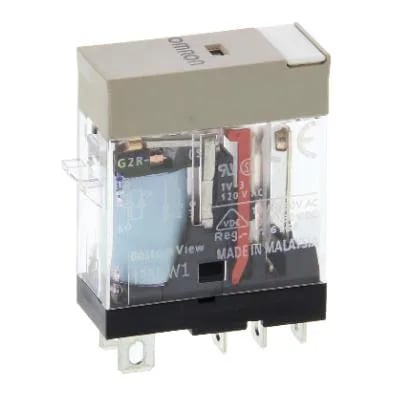
The relay that fits the old footprint
The Omron G2R-2-SD DC24(S) is a plug-in general purpose relay from the G2RS series, with a 24V DC coil and a DPDT (2-pole, double-throw) contact arrangement on an 8-pin base — the form factor that drops into the standard 8-pin relay socket already common in 1990s-era control panels.
Contact ratings and the dielectric envelope
The contacts are rated for low-signal general-purpose switching — 5 A at 250V AC and 5 A at 30V DC, with lower figures (2 A / 3 A) also published depending on the duty category. That makes the relay a fit for control-circuit loads such as contactor coils, solenoid valves, pilot lamps and auxiliary interlock wiring, not for direct motor power switching. Dielectric strength is 1,000V AC between contacts of the same polarity, 3,000V AC between opposite-polarity contacts, and 5,000V AC between coil and contacts — tested for one minute at 50/60 Hz. The 5,000V coil-to-contact figure is what gives the relay the isolation margin to sit on the same DIN-rail backplate as 230V contactor coils without cross-talk through the coil drive circuit.
Durability, indication, and operator interface
Electrical operating life is rated at 100,000 operations and mechanical life at 10,000,000 to 20,000,000 operations — the spread is typical for the series and reflects the difference between cycles that actually arc across the contacts and the no-load cycles the mechanism survives. A mechanical flag on the relay body gives the visual state indication that matters during commissioning and fault isolation, and there is no test button on this variant. The 8-pin pin-style electrical connection keeps the swap order identical to whatever socket is already wired into the panel.
Lifecycle and the BOM line
The ledger lists the as current under the Omron brand — the relay is still a live part number rather than a phase-out. For a retrofit job, that means it can be specified into the BOM as a drop-in replacement for an existing G2RS-series device without a board spin, as long as the socket footprint and pinout match what is already wired in.