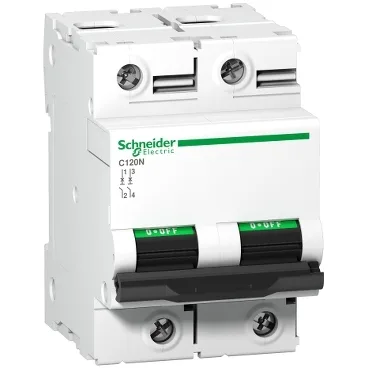
The A9N18363 is a 2-pole miniature circuit breaker from Schneider Electric's Acti9 C120N range, rated 125 A at 30 °C with a C-curve (magnetic trip 5–10 × In). The 6 kA Icu at 440 V AC per EN/IEC 60947-2 is the ultimate breaking capacity for industrial panel duty where the fault current may be higher; you size the upstream protection to stay within whichever rating governs your installation standard. Thermal-magnetic trip technology means the bimetal handles overloads (slow, heat-dependent) while the solenoid handles short-circuits (instantaneous above the magnetic threshold). This is the standard for distribution applications — no electronics to fail, no auxiliary power needed to trip.
Clip-on mounting to 35 mm symmetrical DIN rail, 6 module pitches at 9 mm each — 54 mm total width. That's the standard footprint for a 2-pole 125 A MCB in the Acti9 system; it snaps into the same rail as the rest of the distribution board. Tunnel terminals accept 1–50 mm² rigid or 1.5–35 mm² flexible copper. Strip length 15 mm, tightening torque 3.5 N·m. The terminal capacity is generous for a 125 A breaker — you can land a 50 mm² feeder without a ferrule, which matters when the incoming cable runs warm from the mill transformer. IP20 finger protection on the front face; inside the enclosure that's fine, but keep it behind a gland plate if the panel sees washdown or dust.
Dual-rated to EN/IEC 60947-2 (industrial) and EN/IEC 60898-1 (household / commercial). That dual certification is the key for a panel that crosses between a utility supply and an industrial load — the breaker satisfies both the installation standard and the equipment standard. That's the standard for non-condensing humid environments — fine for most indoor panels, but if the panel sits in a washdown zone or a tropical outdoor cabinet, verify the enclosure keeps condensation off the terminals. That's a real advantage in a multi-level distribution board: the MCB itself limits the fault energy, so you can use lower-rated busbars or downstream breakers.