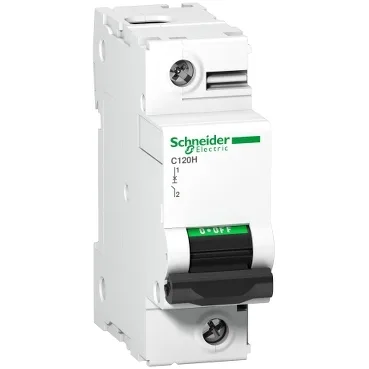
The A9N18403 is a 1-pole Acti9 C120H miniature circuit-breaker rated 100 A at 30 °C with a B-curve trip characteristic (magnetic tripping between 3 and 5 times In). The B curve means it holds through moderate inrush (resistive loads, lighting banks, control transformers) but trips fast on a hard short: magnetic pickup starts at 300 A and is guaranteed by 500 A. Breaking capacity is 15 kA Icn at 230/400 V AC per EN/IEC 60898-1, and 15 kA Icu at 220…240 V AC per EN/IEC 60947-2. That 15 kA at 230/400 V is the fault current it can safely interrupt without welding contacts or rupturing the case — enough for most commercial and light industrial distribution boards fed from a typical 200–400 kVA transformer. The dual standard (60898-1 for household-type installation and 60947-2 for industrial application) means this breaker can serve in either a consumer unit or an industrial panel, as long as the prospective short-circuit current at its mounting point stays under 15 kA. At 27 mm wide (3 x 9 mm pitches), a single-pole breaker takes one module position, so you can pack 12 poles per 360 mm of DIN rail. The tunnel-type terminals accept up to 50 mm² rigid or 35 mm² flexible cable, with a tightening torque of 3.5 N·m and a strip length of 15 mm — sized for the 100 A feed conductor.
Sourcing and lifecycle — active, no end-of-life signal
Compliance documentation is straightforward: the breaker is certified to EN/IEC 60898-1 and EN/IEC 60947-2, carries IP20 finger protection, and is suitability marked for isolation per IEC 60947-2.
Integration into a distribution board
The A9N18403 sits in a standard 35 mm DIN-rail enclosure. Its 73 mm depth and 81 mm height fit within the envelope of a typical 200 mm deep distribution board, leaving clearance for outgoing cables and busbar connections. The toggle control provides local ON/OFF indication and a contact position indicator — useful for lockout/tagout verification without removing the front cover. Electrical durability is rated at 5000 cycles per IEC 60947-2, mechanical durability at 20,000 cycles. For a distribution breaker that sees infrequent switching (maybe a few operations per year during maintenance), that endurance is effectively unlimited.