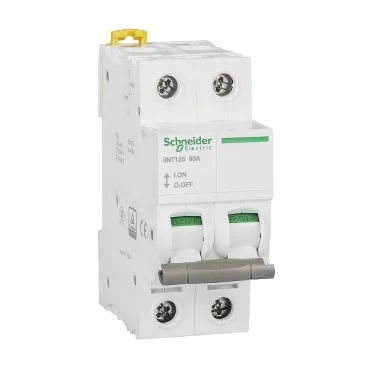
Switch disconnector for control isolation
The Schneider Electric A9S68280 is a 2-pole switch disconnector from the Acti9 iINT range, rated for 80 A at 400 V AC (50/60 Hz) with a 415 V operational voltage. It's built for control isolation duty per GB 14048.3, meaning it provides visible isolation and safe disconnection of circuits during maintenance — the toggle gives positive ON/OFF indication so the panel guy knows the circuit is dead. The AC-22A utilisation category covers switching of mixed resistive and inductive loads, including moderate motor loads, up to the rated current. At 80 A it handles most sub-distribution and machine isolation points in a standard 400 V three-phase panel.
Rated insulation voltage (Ui) is 500 V AC, so it's comfortable on 400 V systems with margin. Impulse withstand (Uimp) at 6 kV covers typical transient overvoltages in industrial environments (pollution degree 3). Short-time withstand (Icw) of 1500 A for 1 second means it can ride through a fault long enough for an upstream breaker to clear — important for selectivity coordination. Short-circuit making capacity (Icm) is 5 kA when the switch-disconnector stands alone. That's the peak asymmetrical current it can close onto without welding contacts. For fault levels above that, the upstream protective device must limit let-through energy. For a manual isolation switch used maybe once per shift, that's a long service life — well past the panel's expected overhaul interval.
Mounts on standard DIN rail (35 mm), 2-pole width at 36 mm (4 x 9 mm pitches). Fixed mounting mode — no adapters needed. Tunnel-type terminals accept rigid cable up to 50 mm², flexible up to 35 mm² (with or without ferrule). Strip length 14 mm, torque to 3.5 N·m. Tropicalisation class 2 means it handles humidity up to 95% at 55 °C without condensation issues — suitable for non-air-conditioned plant rooms in warm climates. Top or bottom busbar and distribution block compatible, giving flexibility in panel layout for vertical or horizontal busbar runs.