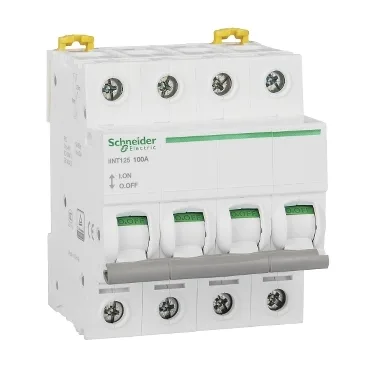
It carries a rated operational current of 100 A at 400 V AC 50/60 Hz and a rated operational voltage of 415 V AC 50/60 Hz. The utilisation category is AC-22A, meaning it is designed for switching mixed resistive and inductive loads, including moderate motor loads, in distribution panels. This device is explicitly marked as suitable for isolation, with a contact position indicator and ON/OFF local signalling. That makes it a legitimate isolation point for downstream circuits during maintenance — not just a load-break switch.
For motor circuits, the AC-22A category covers switching of mixed loads, so it will handle starting currents of motors up to roughly 30 kW depending on duty cycle — but it is not a dedicated motor-protective device. The rated short-time withstand current (Icw) is 1500 A, and the rated short-circuit making capacity (Icm) is 5 kA for the switch-disconnector alone, which gives you the fault-closing capability to safely close onto a downstream short circuit. The rated insulation voltage (Ui) is 500 V AC, and the impulse withstand voltage (Uimp) is 6 kV, so the part is comfortable in 400 V panels with typical transient overvoltages.
Mounts on DIN rail with a fixed mounting mode. The 4-pole unit occupies 8 x 9 mm pitches (72 mm width). Terminal connections are tunnel-type, accepting 6...50 mm² rigid or 6...35 mm² flexible (with or without ferrule) on top or bottom. The operating temperature range is -25 to 60 °C, storage -40 to 85 °C, with 95 % relative humidity at 55 °C.