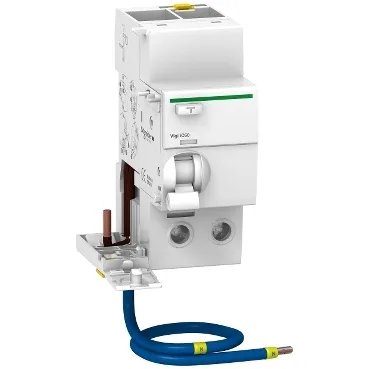
It's a 1P+N unit rated at 25 A with a 10 mA trip sensitivity, Type A (pulsating DC and AC sinusoidal earth leakage). The voltage-independent tripping technology means it detects leakage and disconnects even if the phase voltage is lost — no auxiliary supply needed.
The 10 mA sensitivity is the standout here — that's a high-sensitivity trip threshold, typically specified for circuits where direct contact with live parts is a credible risk (e.g., socket outlets in bathrooms, construction sites, or medical locations per IEC 60364). The 25 A rated current (In) matches standard final-circuit loads like lighting, general-purpose socket rings, or small appliances on a 240 V AC single-phase network. Type A protection covers both sinusoidal AC leakage and pulsating DC leakage from rectified loads — think electronics, LED drivers, or variable-speed appliances downstream. The voltage-independent trip mechanism is a reliability advantage: it doesn't rely on the mains voltage to operate, so a lost neutral or phase doesn't defeat the protection.
Bottom tunnel terminals accept 1…25 mm² rigid or 1…16 mm² flexible cable, with a 14 mm strip length and 2 N·m tightening torque. It's compatible with bottom-entry comb busbars. The IP20 enclosure is standard for distribution boards; the IP40 rating applies when enclosed in a modular enclosure. The trip indicator gives local visual signalling of a residual current trip.
Designed and certified to IEC 61009-1 and EN 61009-1 (the harmonized standard for RCBOs and RCCBs with overcurrent protection integration). The insulation voltage (Ui) is rated 500 V AC, impulse withstand (Uimp) is 6 kV per IEC 60947-2, and pollution degree 3 per IEC 60947-2 — suitable for industrial environments where conductive pollution is present. The 8/20 µs impulse withstand of 250 A per IEC 61009-1 confirms it handles surge currents without nuisance tripping.