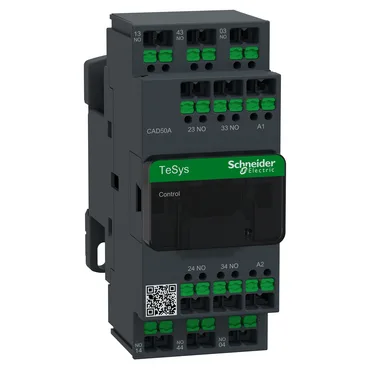
The CAD50AB7 is a TeSys Deca control relay from Schneider Electric, built for switching control circuits in industrial panels. It carries five normally-open contacts, a 24 V AC standard coil, and is rated for operational voltages up to 690 V. This is the part you spec when you need a reliable, globally approved relay for a control cabinet that sees moderate shock and vibration — the mechanical robustness ratings (10 Gn shock open, 15 Gn closed; 2 Gn vibration open, 4 Gn closed per IEC 60068-2-27 and -2-6) tell you it holds contact integrity on a machine that cycles or vibrates. The utilisation categories cover AC-15 (solenoid valve and electromagnetic clutch loads), AC-14 (small motor loads up to 72 VA), and DC-13 (solenoid loads with parallel diode suppression). That means it handles the typical control-circuit loads you find in conveyor interlocks, valve manifolds, and motor starter auxiliaries — not power switching, but signal-level reliability where a welded contact means a line stoppage.
Standards and approvals — what they mean for global installs
This relay carries approvals across EN/IEC 60947-5-1, UL 60947-5-1, CSA C22.2 No 60947-5-1, GB/T 14048.5, and JIS C8201-5-1. That is the full set for control-circuit devices in Europe, North America, China, and Japan — so if you are freezing a BOM for a machine that ships to multiple regions, this single part number covers the certification gate without a variant swap. The IP2X front-face protection (per VDE 0106) means the relay's front is finger-safe against accidental contact inside an open panel. It is not washdown-rated — that is standard for a panel-mounted control relay — but the TH protective treatment per IEC 60068 confirms it handles humid, tropical environments without creepage failure.
Snap-in terminals and a 45 mm width mean it clips directly onto a DIN rail alongside other TeSys Deca components — contactors, overloads, auxiliary blocks — without needing extra mounting hardware. Ambient operation from -40 to 60 °C (with derating up to 70 °C) covers most non-conditioned electrical rooms; the -60 to 80 °C storage range means it can sit as a spare in a cold warehouse without issue.