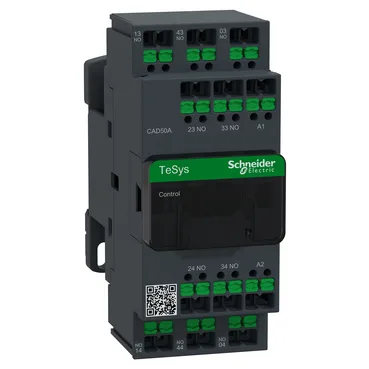
The 5 NO pole composition means all five contacts close when the coil is energised — no mixed NO/NC configuration, so it is suited for applications needing multiple simultaneous control signals (e.g., enabling several contactors or PLC inputs from one command). Its utilisation categories tell you what loads it can switch: AC-15 (solenoid valves, electromagnetic brakes — inductive loads above 72 VA), AC-14 (small electromagnets, clutches — inductive loads up to 72 VA), and DC-13 (solenoids with series resistor — DC inductive loads). Rated operational voltage is listed at 10 MOhm — that is the insulation resistance between live parts, not a switching voltage. The device short name CAD and the TeSys range place it in Schneider's standard-duty control relay family, snap-in terminal style for DIN-rail mounting.
At 45 mm wide and 107 mm tall, it occupies one standard modular space — plan your enclosure fill factor accordingly. Depth of 93 mm means it clears most 120 mm deep enclosures but check gland-plate clearance if wiring from the rear. Storage range of -60 to 80 °C is wider — handling and shipping, not running, is what that limit governs. Mechanical robustness is specified for shock and vibration: 10 Gn for 11 ms when open, 15 Gn when closed; vibration at 2 Gn (open) and 4 Gn (closed) across 5–300 Hz. These are the values to check against your machine's vibration profile — if you are mounting on a press or crusher, the closed-contact rating is the relevant one.
Multi-standard compliance covers EN/IEC 60947-5-1, UL 60947-5-1, CSA C22.2 No 60947-5-1, GB/T 14048.5, and JIS C8201-5-1. This means the same part number works across European, North American, Chinese, and Japanese installations — no region-specific variant needed. The TH protective treatment (IEC 60068) confirms it is tropicalised for humid environments.