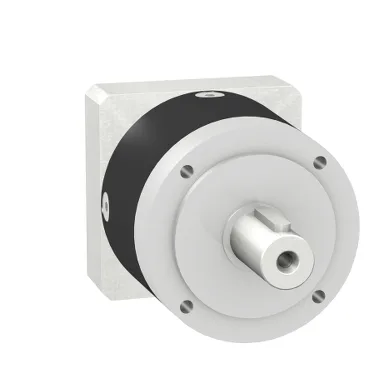
The GBX1600120551F is a 160 mm-frame planetary gearbox with a 12:1 reduction ratio, straight spur teeth, and a black anodized aluminium housing. It's sized for applications where the motor runs at moderate speed and the load needs a torque step-up without a belt drive. Continuous output torque is 800 N.m at 100 rpm and 30 °C — this is the rating for sustained duty, not the peak the gearbox can survive momentarily. Maximum output torque is 1280 N.m under the same conditions, which covers starting and short-duration overloads. The 30000-hour service life at those figures means a maintenance planner can schedule replacement at a known interval, not guess. Torsional rigidity is 41 N.m/arcmin and maximum backlash is 10 arc.min. For a positioning axis, that backlash figure is the lost motion at reversal — if the application indexes and holds position, 10 arc.min may be acceptable; for a continuous-path servo axis, a lower-backlash gearbox would be needed.
Sourcing reality — obsolete, sourced through independent channels
Schneider Electric lists this gearbox as obsolete. The part is available through independent surplus and broker channels — quantities are lot-specific and confirmed at RFQ. For a line-down replacement or a BOM that needs this exact frame size and ratio, the procurement path is a quoted-to-order search against the part number. No pin-compatible drop-in replacement from Schneider is documented.
Mechanical interface and environmental limits
The output shaft is C45 medium-carbon steel. The housing is black anodized aluminium — lighter than cast iron but with adequate corrosion resistance for indoor industrial environments. Shaft output seal is rated IP54, meaning it's protected against dust ingress and splashing water, but not submersion or high-pressure washdown. The gearbox is lubricated for life — no oil changes or regreasing intervals, which simplifies installation in hard-to-access locations. Maximum axial force on the output shaft is 6000 N for the 30000-hour life, or 8000 N for a 10000-hour life at 100 rpm. Maximum radial force is 4200 N for 30000 hours, 6000 N for 10000 hours, measured at mid-span on the shaft. These limits govern belt-pulley or chain-sprocket overhung loads — exceeding them shortens bearing life faster than the torque rating would suggest.
Efficiency and noise — operational tradeoffs
Efficiency is listed at 94 % — typical for a single-stage planetary with straight teeth. The straight-tooth profile is simpler to manufacture than helical, but generates more noise: 70 dB at 1 m no-load. In an operator-occupied area, that noise level may require enclosure treatment or hearing protection depending on local exposure limits.