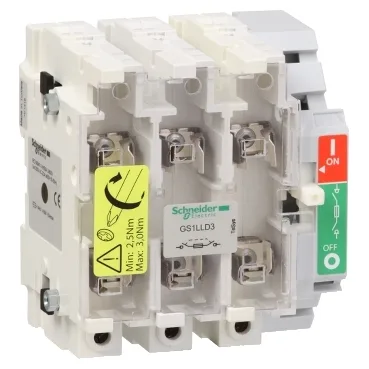
Switch-disconnector-fuse for motor branch circuits
The GS1LLD3 is a TeSys GS switch-disconnector-fuse, 3-pole, rated 160 A at 400 V in AC-23B duty — the AC-23B category covers occasional switching of motor loads including starting, stopping, and plugging, so this is the rating that governs real motor branch-circuit use, not the thermal current figure. It carries a short-circuit withstand of 22.7 kA and a making capacity of 1600 A at 400 V AC-23B, meaning it can close onto a fault and hold the fault current until the upstream fuse clears — essential for coordination in a panel with high available fault current.
Rated power and voltage coverage
Rated operational power is 90 kW at 400 V, 110 kW at 500 V, and 110 kW at 690 V — the same power at 500 V and 690 V tells you the current limit (160 A) is the binding constraint above 500 V, not the insulation. Rated insulation voltage is 750 V AC, impulse withstand 8 kV, and the body passes 960 °C glow-wire per IEC 60695-2-1 — the fuse cover is rated to 850 °C, so the cover is the thermal weak point if a fuse blows under sustained arcing.
Mounting and integration constraints
Mounts on a plate (not DIN rail), with a direct right-side operating handle — the handle position limits how closely units can be ganged side-by-side; allow clearance for the handle swing on the right side of each unit. Power circuit connections accept bars or lugs/ring terminals for 50–95 mm² flexible cable, torqued to 12 N·m — the lug option is useful for retrofitting into existing buswork without re-terminating the cable. IP20 with the terminal cover fitted — the cover is required for touch-safe operation; without it the live terminals are exposed. Storage temperature range -40 to 80 °C, operation -20 to 70 °C.
Lifecycle and sourcing posture
Compliant with IEC 60947-3 for switch-disconnector-fuse function.