Where this drive sits in the machine
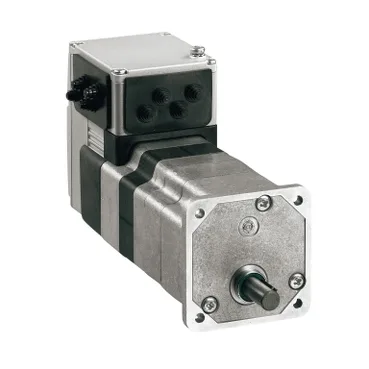
The part is a Schneider Electric ILE1B661PB1A1, a brushless DC integrated servo drive in the Lexium ILE line — motor, encoder feedback and 3-stage gearing in one flange-mount body sized to a 66 mm flange. It targets low-voltage DC bus motion on conveyor diverters, indexing tables, small-format packaging gates and similar mechatronic stations where an all-in-one axis is preferable to a separate drive and gearbox.
Speed, torque and the 24 V vs 36 V trade
Nominal output is 74 W at 24 V (225 rpm, 3.1 N.m) and 98 W at 36 V (270 rpm, 3.5 N.m). Peak stall torque rises to 3.74 N.m at 24 V and 5.18 N.m at 36 V, so the higher-voltage envelope gives both more continuous work and more headroom for transient stalls before tripping the integrated output protection. Current draw peaks at 7 A with 5.5 A maximum continuous — worth derating against the upstream 24 V or 36 V supply sizing on a multi-axis machine, since the converter budget compounds across axes. The detent torque of 1.1 N.m is the residual cogging you feel at zero commanded speed, which matters for positioning accuracy at standstill.
Gearbox, shaft and feedback
A 3-stage straight-tooth gearhead at 18:1 (160:9) reduction is integrated in the housing, so the low-speed shaft runs at the listed 225/270 rpm rather than the motor's bare speed. The 10 mm keyed shaft with 25 mm length and 16 mm key is the only output interface; there is no second shaft end and no holding brake option on this build, so a fail-safe brake must live on the downstream mechanism if the application needs it.
Compliance, protection and environment
The drive is CE marked and built to IEC 61800-3 (second environment), EN/IEC 50178, EN 50347 and IEC 60072-1. Integrated protection covers output overvoltage, safe torque off, and output short-circuit, which keeps the safety circuit simple on a single-axis station. Mechanical robustness is rated 150 m/s² for 1000 shocks and 20 m/s² over 10–500 Hz on 10 cycles per EN/IEC 60068-2-6/-2-29, with natural-convection cooling (no fan), operation to 1000 m altitude without derating, and 15–85 % non-condensing humidity — so it fits a sealed panel with a heat-sink plate rather than a forced-air cabinet.