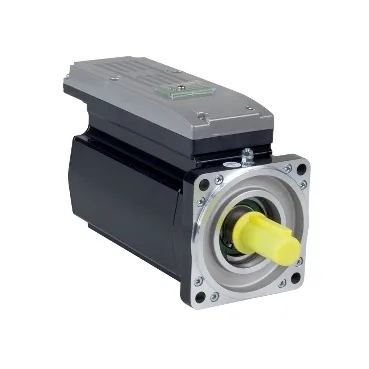
Where the ILM1003P31A0000 sits in the PacDrive 3 stack
The ILM1003P31A0000 is the integrated-drive variant of Schneider's ILM family under the PacDrive 3 range — a 3-stack, 8-pole brushless servo motor with the drive electronics packaged on the rear of the housing rather than as a separate cabinet module. It is rated 1100 W nominal output at 3000 rpm and 3.5 N.m continuous nominal torque, with a peak stall envelope of 28.3 N.m available for acceleration transients — a ratio of roughly 8× over nominal that the motion controller uses for short move profiles.
Torque and current envelope that drives the sizing decision
Peak Irms of 21.2 A is the thermal ceiling the drive enforces during acceleration; the winding constant of 1.61 N.m/A at 120 °C tells you the torque-per-amp slope shifts upward once the motor is hot, so the same current command produces slightly more torque at working temperature than at cold start. Back-EMF constant is 103 V/krpm at 20 °C, which sets the bus-voltage headroom: at the 3000 rpm nominal point the generated EMF is roughly 310 V, so a 400 V-class DC bus is required to retain regulation margin at top speed.
Feedback, shaft, and mechanical load envelope
Position feedback is Hiperface SinCos absolute single-turn at 128 periods per revolution — the absolute channel eliminates the homing move on power-up, which matters for any machine that has to be position-ready the moment the safety circuit closes. The shaft is 19 mm diameter, 40 mm long, with a 30 mm keyway and no second shaft end and no holding brake — that combination rules out any axis that needs a fail-safe spring-applied brake (a vertical unpowered load will coast), so the ILM1003P31A0000 is sized for horizontal or pre-balanced axes. Maximum radial load is 1050 N at 1000 rpm, dropping to 830 N at 2000 rpm and 730 N at 3000 rpm — bearing life is governed by the belt tension or pinion gear mesh reaction at the rated speed, so a high-ratio timing-belt drive should be checked against the 3000 rpm value rather than the headline figure. Axial load is permitted up to 0.2 × Fr, which is the limit when a coupling or a helical pinion is pushing along the shaft — anything beyond that needs a separate thrust bearing in the gearbox housing.
Sealing, cooling, and cabinet integration
Cooling is natural convection, so there is no fan to fail and no dust path into the rotor — the flip side is that continuous torque must be derated if the motor is enclosed in a heat-soaking cabinet, and the IP65 rating on the housing seals against water jets but assumes the cable gland is also torqued against its O-ring. The 100 mm flange with 95 mm centring collar and four M9 mounting holes drops into the standard IEC footprint — the rear-of-motor integrated drive adds length beyond a conventional servo of the same frame, so cabinet depth has to allow for the drive housing plus the bend radius of the hybrid cable to the PacDrive controller.
Stator model for commissioning and drive tuning
Stator resistance is 2.6 Ohm phase-to-phase at 20 °C (1.81 Ohm phase-to-neutral at 120 °C) and inductance is 15.6 mH phase-to-phase at 20 °C — these are the values the auto-tune routine uses to set the current-loop bandwidth, so any error in cable resistance on long motor leads shows up as a tuning residual rather than as a thermal fault.