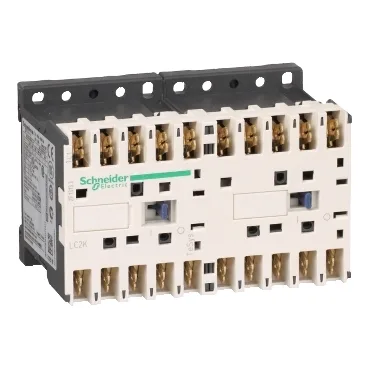
It carries 4 NO power poles, a 127 V AC 50/60 Hz control coil, and is rated for AC-1 resistive loads at 20 A (Ith). The mechanical interlock is built in — no external linkage to align. For a panel builder wiring a reversing starter, that saves one assembly step and removes a common misalignment failure point.
The coil is 127 V AC 50/60 Hz — a common control voltage in North American and some European panels. Verify your control transformer taps before committing the BOM line.
The AC-1 utilisation category (resistive load) is the rating that governs this contactor's thermal current. At 20 A Ith, it handles heater banks, lighting, or transformer primary switching. It is not rated for AC-3 motor duty — if you are switching a squirrel-cage motor, you need a contactor with an AC-3 rating. Electrical durability is 0.3 Mcycles at 20 A AC-1, 440 V. Mechanical durability is 5 Mcycles. The B10d safety reliability figure is 1,369,863 cycles at nominal load per EN/ISO 13849-1, which qualifies it for safety-related stop circuits where the contactor is the final switching element. The 57 mm depth and 90 mm width fit a standard 4-pole contactor footprint. IP20 finger-safe terminals per VDE 0106 — suitable for enclosed panels, not for washdown environments. Rated insulation voltage is 600 V per UL 508 and CSA C22.2 No 14, 690 V per IEC 60947-4-1. Overvoltage category III means it is rated for fixed-installation distribution-level transients. The built-in bidirectional peak limiting diode suppressor handles coil suppression — no external flyback diode needed on the 127 V AC coil. Inrush is 30 VA at 20 °C; holding dissipation is 1.3 W.
Designed and certified to BS 5424, VDE 0660, IEC 60947, and NF C 63-110. Flame retardance is V1 per UL 94. Protective treatment meets IEC 60068 and DIN 50016 for tropical climate resistance. The associated fuse recommendation is 25 A gG or 25 A aM for the power circuit. That sets the short-circuit protection rating for the branch circuit feeding this contactor.