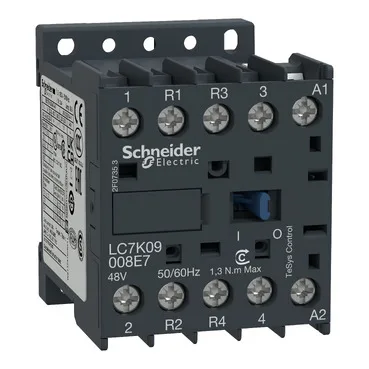
The Schneider Electric LC7K09008E7 is a TeSys-series contactor, a 4-pole device (2 normally open + 2 normally closed) with a 48 V AC 50/60 Hz coil. It is rated for 20 A in AC-1 utilisation category (resistive loads) at voltages up to 690 V, making it a straightforward choice for switching resistive heating elements, lighting banks, or transformer primaries in a control panel. The 4-pole configuration gives you two sets of NO and NC power contacts in one package, which can simplify wiring for applications needing both a main and an auxiliary contact function without a separate add-on block.
The headline rating here is 20 A AC-1 at ≤690 V. AC-1 covers resistive loads — heaters, incandescent lamps, resistors — where the inrush current is minimal. Do not use this contactor for motor starting (AC-3) or inductive loads without checking the manufacturer's derating; the 20 A AC-1 figure is not a universal current rating. The rated breaking capacity of 110 A at 220–440 V (per IEC 60947) tells you it can interrupt a fault up to that level, which is useful for coordination with a 25 A gG or aM upstream fuse. The coil pulls 3 VA inrush at 20 °C and dissipates 3 W holding, so it's light on the control transformer. Mechanical durability is 10 million cycles, electrical durability 0.16 million cycles at full AC-1 load — the electrical life is the limiting factor if the contactor cycles frequently under load.
Screw-clamp terminals accept 1.5 to 4 mm² solid or 0.75 to 4 mm² flexible wire (with or without ferrules). Tightening torque is 0.8 to 1.3 N·m. The IP2X finger protection (per VDE 0106) is standard for enclosed panel gear; no special sealing for washdown environments. The contactor carries approvals across EN/IEC 60947-4-1, UL 60947-4-1, CSA C22.2 No 60947-4-1, and JIS C8201-4-1, so it is accepted in most global markets without a separate qualification step.