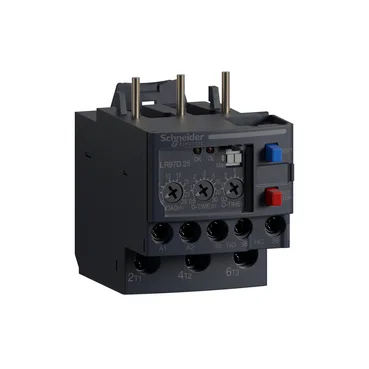
Its tripping threshold covers 5 to 21 A, making it suitable for protecting motors in that current range against overload, phase failure, and locked rotor conditions. Rated supply is 48 V AC/DC, and it handles operational voltages up to 690 V AC on the power circuit per IEC 60947-4-1. The thermal protection adjustment range is 5 to 25 A, giving a bit of headroom above the tripping threshold for fine-tuning. It mounts directly on a contactor or on a DIN rail, so it integrates into a standard motor starter assembly without extra bracketing. The IP20 enclosure means it's suited for installation inside a panel rather than exposed to washdown environments.
The tripping threshold of 5 to 21 A is the current range where the relay will detect an overload and trip. For a motor with a full-load current of, say, 10 A, you'd set the dial within this band. The wider thermal protection adjustment range (5 to 25 A) allows the relay to be used on motors where the full-load current is near the top of the threshold range, but the real decision point is the 5–21 A tripping window. Phase failure sensitivity is under 3 seconds, which means if one phase drops out, the relay will trip the motor off within that time to prevent single-phasing damage. The time ranges (0.2–10 s, 0.3–10 s, 0.5–30 s) correspond to different trip curves selected via knobs, letting you match the protection to the motor's starting characteristics. The single C/O contact provides one normally-open/normally-closed changeover for signaling the trip to a PLC or contactor coil. That's enough for a basic starter but won't give you separate alarm and trip outputs without an aux contact block.
Designed and tested to IEC 60255-6 and IEC 60947, with a rated insulation voltage of 690 V per IEC 60947-4-1 and 600 V per UL and CSA. Dielectric strength is verified at 2 kV, 50 Hz per IEC 60255-5. Surge withstand is 6 kV per IEC 61000-4-5.