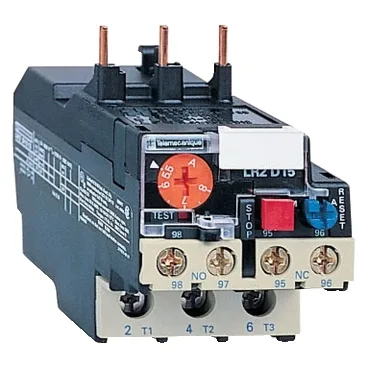
The Schneider LRD15226 is a differential thermal overload relay from the TeSys Deca series, designed for motor protection in industrial control panels. Its thermal protection adjustment range spans 17 to 25 A, so it directly protects motors with a full-load current in that band. The differential mechanism detects phase-loss conditions: it trips at 130 % of the set current on two phases when the third is at zero — a common failure mode in blown-fuse or broken-wire scenarios. The relay carries 1 NO + 1 NC auxiliary contacts rated at 1.5 A at 240 V AC-15 for signalling circuits, and 0.1 A at 250 V DC-13. These are the contacts that interrupt the contactor coil circuit on a trip, so the ratings govern what control voltage and load the relay can switch directly.
Because it is obsolete, there is no direct drop-in successor with the same order code. A cross-reference to a current-production equivalent requires verifying the mounting footprint (mounts under the contactor or on a plate/rail with specific accessories), the 17-25 A adjustment range, and the Class 20 trip curve — any substitution must match these three parameters to avoid a panel rework.
The relay is certified to EN/IEC 60947-4-1 and 60947-5-1, plus UL 60947-4-1 and 60947-5-1, and CSA C22.2 No 60947-4-1 and 60947-5-1. This means it is accepted in IEC-mark and North American (UL/CSA) jurisdictions for motor starter applications — no additional agency review needed for a panel build destined for those markets. Rated insulation voltage (Ui) is 600 V for CSA/UL and 690 V for IEC, with an impulse withstand voltage (Uimp) of 6 kV. The dielectric strength test is 1.89 kV at 50 Hz. Flame retardance is V1 per UL 94, and fire resistance is 850 °C per IEC 60695-2-1. IP20 protection means it is finger-safe but not sealed — it belongs inside an enclosure, not in a washdown or outdoor location.