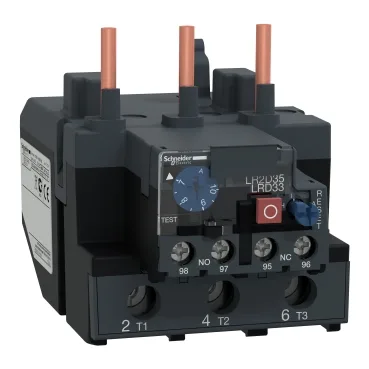
The LRD3314 is a differential thermal overload relay from the TeSys Deca range, designed to protect motors against overload, phase failure, and phase imbalance. It mounts directly to the LC1D80 contactor, forming a compact motor starter package for a panel. The thermal protection adjustment range is 7-10 A, which means you set the dial to match the motor's full-load current — the relay then tracks the thermal state of the motor windings via a bimetallic strip heated by the line current. Trip class is Class 10A per IEC 60947-4-1, so it will trip within 10 seconds at 7.2× the set current. That's the standard for general-purpose motor starting — it lets the motor accelerate under load without nuisance tripping but still clears a stalled rotor fast enough to prevent winding damage. Phase failure sensitivity is built in: the relay trips at 130 % of Ir on two phases when the third is at zero. That catches a blown fuse or broken wire before the motor single-phases to failure.
Mounts directly under the LC1D80 contactor — no separate wiring between the contactor and the overload for the power circuit. The auxiliary contact composition is 1 NO + 1 NC, wired into the control circuit to signal the trip and to break the contactor coil. The red push-button is stop (manual trip test), the blue push-button is reset. IP20 finger-safe protection is fine inside a closed panel. The signalling circuit is rated 3 A at 120 V AC-15 and 0.22 A at 125 V DC-13. That's enough for a PLC input or a relay coil, but watch the DC rating if you're switching a DC contactor or a DC-powered indicator — the DC-13 value is the inductive load limit. Associated fuse rating is 4 A gG or 4 A BS for the signalling circuit.
Approvals cover the major industrial markets: EN/IEC 60947-4-1 and 60947-5-1, UL 60947-4-1 and 60947-5-1, CSA C22.2 No 60947-4-1 and 60947-5-1, plus GB/T 14048.4 and 14048.5 for the Chinese market. Climatic withstand conforms to IACS (marine/offshore). Dielectric strength is 2.2 kV at 50 Hz per IEC 60947-1, and rated impulse withstand voltage is 6 kV. Temperature compensation is active from -20 to 60 °C, so the trip curve stays accurate across the panel's ambient range without derating. Dimensions: 81 mm high, 70 mm wide, 115 mm deep. The depth is the dimension that projects forward from the contactor face — check clearance to the enclosure door or busbar system.