Motor specs that decide the fit
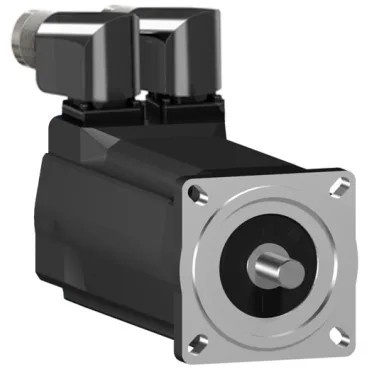
The SH30701P11F2100 is a three-phase servo motor from Schneider Electric's SH3 family, rated 690 W continuous power with natural convection cooling. It delivers nominal torque of 12.4 lbf.in (1.4 N.m) on single-phase 115 V or 230 V supply, and 9.7 lbf.in (1.1 N.m) on three-phase 400 V or 480 V supply — the torque curve shifts with the voltage you feed it. Nominal speed ranges from 1500 rpm on 115 V single-phase up to 7200 rpm on 480 V three-phase, so the same motor body covers a wide speed window depending on the drive and supply you pair it with. Peak stall torque is 31.0 lbf.in (3.5 N.m) across the 115–480 V three-phase range — that's the short-duration torque for acceleration or overcoming load inertia during a move profile.
Built-in holding brake and encoder feedback
This motor ships with a holding brake — holding torque 26.6 lbf.in (3 N.m) — so it holds the load position when power is removed, which saves adding an external brake resistor or mechanical lock on the axis. Feedback comes from an absolute single-turn SinCos Hiperface encoder — single-turn means it reports position within one revolution at power-up without a homing cycle, and the SinCos analog track gives high-resolution interpolation for the drive.
IP65 rating and mechanical mounting
Both the motor body and the shaft bushing carry IP65 per IEC 60034-5 — the housing seals against dust ingress and low-pressure water jets, so it's suited for washdown areas or dusty production lines without a secondary cover. The motor flange is 70 mm (2.8 in) with a centring collar depth of 0.10 in (2.5 mm) and mounting holes on a 5.5 mm diameter — this is the standard IEC flange pattern that mates with most planetary gearboxes and linear actuators in the same frame size. Shaft diameter is 0.4 in (11 mm) with a parallel key and key width 0.2 in (4 mm) — the key transmits torque to the load coupling; the shaft length of 0.9 in (23 mm) gives enough engagement for a standard clamping hub.
No official successor or cross-reference is listed — this is the active variant in the SH3 frame size, so the BOM line stays stable as long as the machine design uses this flange and encoder type.