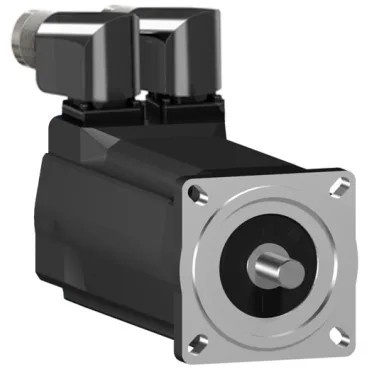
1130 W servo motor with integral holding brake
The SH30702P02F2200 is a Schneider Electric SH3 series servo motor delivering 1130 W continuous power from a 70 mm flange frame. It includes a holding brake rated at 3 N.m (26.6 lbf.in) — this brake holds the load at rest with the drive disabled, so the axis does not drift when power is removed. The brake is integral to the motor; no external brake resistor or separate brake coil wiring is needed. The motor is three-phase and its nominal speed depends on the supply voltage: 1500 rpm on 115 V single-phase, 3000 rpm on 230 V single-phase, 6000 rpm on 400 V three-phase, and 7200 rpm on 480 V three-phase. This means the same motor covers both low-voltage single-phase and high-voltage three-phase lines — the speed range is set by the drive parameterisation, not a motor rewind. The absolute multiturn SinCos Hiperface encoder reports position over multiple shaft revolutions without needing a home cycle on power-up. This is the deciding factor for a gantry or rotary table that must resume position after a power loss — no reference run, no lost counts.
IP65/IP67 enclosure and natural convection cooling
The motor body carries IP65 per IEC 60034-5, the shaft bushing is also IP65, and the housing is rated IP67. This means the motor withstands hose-down cleaning and temporary submersion — it fits food-and-bev, washdown, or outdoor conveyor lines where a standard IP20 servo would fail from moisture ingress. The IP67 rating on the housing, not just the connector, is the key: the housing seal is the wet-end barrier. Cooling is by natural convection — no external fan or forced air. The continuous torque and power ratings assume free air movement around the flange and housing. If the motor is enclosed in a tight cabinet or mounted with restricted airflow, the continuous stall torque of 2.04 N.m (18.06 lbf.in) across 115-480 V three-phase must be derated. The copper hot-spot temperature limit is 130 °C (266 °F). The torque constant is 0.7 N.m/A at 120 °C (248 °F) — this is the hot torque constant, not the cold value. A drive tuning that uses the cold constant will under-estimate the current needed to hold torque at operating temperature. The back EMF constant is 48 V/krpm at 20 °C (68 °F).
Mounting and mechanical interface — 70 mm flange, smooth shaft
The motor mounts via an international standard flange with a 70 mm (2.8 in) flange size. The centring collar is 60 mm diameter with a 2.5 mm depth. Four mounting holes of 5.5 mm diameter on the flange face — these match the standard 70 mm frame pattern used across the SH3 family. The smooth shaft is 11 mm diameter with a 23 mm shaft length. No keyway or flat — the load coupling must use a clamping or friction-fit method.
Electrical connection and winding data
The motor comes with both a straight connector and a rotatable right-angled connector. The right-angled connector can be rotated to route the cable out of the way in tight panel layouts — useful when the motor is mounted close to a wall or another axis. The stator resistance is 4.2 Ohm and the stator inductance is 29.65 mH. These values set the electrical time constant and the drive's current-loop tuning. The motor has 3 poles. Maximum continuous current Irms is 11.8 A, and the output current 3-second peak is also 11.8 A. The peak stall torque is 7.6 N.m (67.3 lbf.in) across 115-480 V three-phase. Nominal torque varies by supply: 2.15 N.m at 115 V single-phase, 2.1 N.m at 230 V single-phase, and 1.8 N.m at both 400 V and 480 V three-phase. Nominal output power follows the same pattern: 340 W at 115 V, 660 W at 230 V, 1190 W at 400 V, and 1360 W at 480 V.
The motor carries IP65/IP67 ratings conforming to IEC 60034-5. Compliance documentation (RoHS, REACH, UL, IEC) is provided by Schneider Electric with the shipment — request it with the RFQ if needed for your compliance file.