Speed and torque across supply voltages
The SH31001M12F1100: This SH3 servo motor delivers nominal speeds that scale with the supply: 625 rpm on 115 V single-phase, 1250 rpm on 230 V single-phase, 2500 rpm on 400 V three-phase, and 3000 rpm on 480 V three-phase. Nominal torque holds fairly flat across the voltage range — 2.8 N·m at 115 V single-phase, 2.52 N·m at 400 V and 480 V three-phase — so the speed increase comes without a torque cliff. Peak stall torque is 9.6 N·m across the 115 to 480 V three-phase range, and continuous stall torque sits at 2.94 N·m. The 660 W continuous power rating is the thermal ceiling under natural convection cooling — no fan to fail, but the duty cycle needs to respect that limit in a stalled or low-speed hold.
Encoder and feedback — absolute multiturn Hiperface
The built-in absolute multiturn SinCos Hiperface encoder means this motor remembers its shaft position through a power cycle — no homing routine on startup. That saves a few seconds per cycle on a pick-and-place or rotary index table, and it eliminates the home-limit sensor wiring in the cable track. The encoder type also sets the drive compatibility: you need a servo drive with a Hiperface interface, not a generic incremental encoder input. Schneider's Lexium 32 or 28 series with the appropriate feedback option card is the natural pairing, but any third-party drive that supports Hiperface multiturn will read it.
Holding brake and mechanical fit
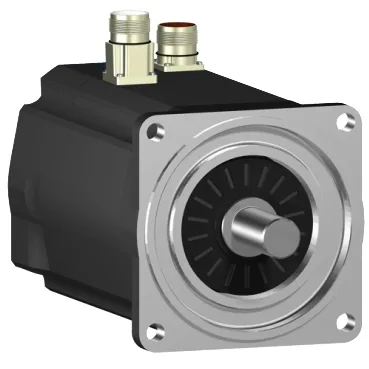
The motor uses a 100 mm international standard flange (B5 pattern) with a 19 mm shaft, parallel key, and 40 mm shaft length. Centring collar is 95 mm diameter, 3.5 mm deep. The IP65 rating on both the motor body and the shaft bushing means it handles washdown environments — food processing or machining coolant — as long as the connector is properly mated.
Electrical parameters and drive sizing
Stator resistance is 13.9 Ω per phase, inductance 34.7 mH — a relatively high-inductance motor that limits current ripple at lower PWM frequencies. Maximum RMS current is 6.3 A, and the torque constant is 1.63 N·m/A at 120 °C copper temperature. The back-EMF constant is 115 V/krpm at 20 °C, which tells you the motor generates about 115 V phase-to-phase for every 1000 rpm of mechanical speed. Maximum radial force on the shaft drops with speed: 900 N at 1000 rpm, down to 530 N at 5000 rpm. Axial force limit is 160 N. If you're direct-coupling a heavy load or using a belt drive, those numbers set the bearing life — overshoot them and the front bearing wears fast.