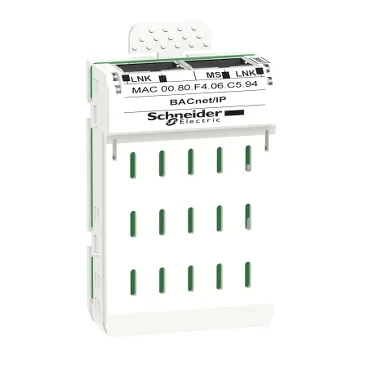
What this card is and why someone is still hunting one down
The TM168MODW is a Modbus TCP/IP communication module designed to drop into the Modicon M168 logic controller family, carrying the BMS connectivity slot that links the base controller to Ethernet networks through two RJ45 ports on 10BASE-T / 100BASE-TX twisted pair at 10/100 Mbit/s.
What the network side actually delivers
The module exposes the standard Modbus TCP/IP service set — SNMP, BOOTP, FTP, and the read/write register functions (03, 04, 06, 16, 23) plus device identification (43/14) — so an integrator can pull the M168 controller onto an existing Ethernet supervisory network without a proprietary gateway. Diagnostic visibility comes from four front-face LEDs covering transmission activity, reception activity (RX), module status, and error, which is the minimum set a controls engineer needs to confirm link state and traffic direction during commissioning or a fault call-out. A built-in web server and a user web page size of 2 MB let the controller serve its own configuration pages directly over HTTP, removing the need for a separate HMI panel for parameter access on machines where only status and setup are required.
Where it physically lives and what it tolerates
Operating temperature spans -20 to 65 °C with storage to -25 to 70 °C and 5 to 95 % non-condensing humidity, and the unit holds its EMC profile against the EN/IEC 61000-6-1 and EN/IEC 60730-1 immunity sets plus the IEC 61800-3 category C1 conducted emissions envelope, which qualifies it for installation next to a drive on the same panel. Mechanical resilience is rated at 15 gn shock for 11 ms and the IEC-standard 1.5 mm / 1 mm / 2 gn vibration sweep from 3 to 150 Hz, with operation specified up to 2000 m altitude — adequate for an enclosed control cabinet on a typical machine or a top-floor equipment room.
Compliance posture and approval footprint
Pollution degree 2 is consistent with an office- or light-industrial cabinet interior — the module should not be specified for an environment where conductive dust or condensation is expected at the card edge.
Sourcing posture for an obsolete slot card
Because the part is recorded as obsolete with no official successor on the same data line, any replacement is a board-level or system-level re-design rather than a like-for-like swap — a buyer specifying this code is patching an existing M168 install where a form-fit-function drop-in is still required.