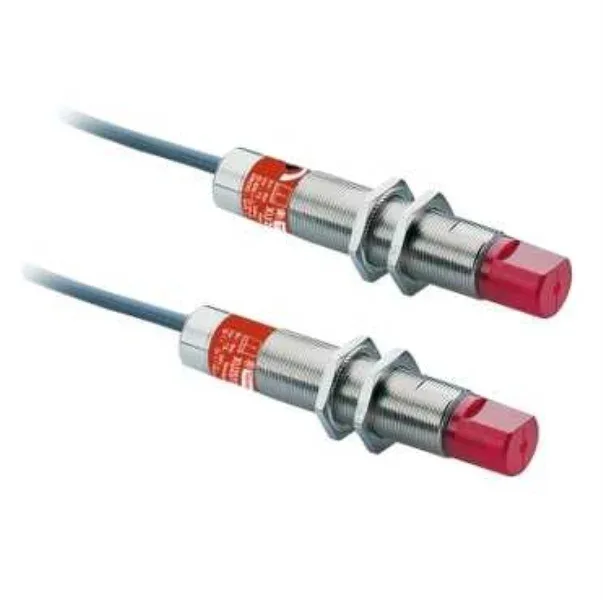
The Square D / Telemecanique XU2S18PP340WL5 is an M18 threaded thru-beam photoelectric sensor from the XU2 series — an infrared emitter/receiver pair built into an 18 mm tubular housing with side-sensing optics, intended to detect part presence or position across an 8 m air gap on a conveyor or machine frame. The body is nickel-plated brass with threaded mounting, sealed to IP67, so it takes typical panel-side washdown and outdoor panel mounting without a separate shroud.
Ratings that drive the BOM fit
Operating voltage spans 12 to 24 VDC, which covers the common 24 V control-rail feed as well as 12 V battery-backed loops — no separate power supply is needed alongside the standard PLC or sensor hub. Sensing distance is rated at 8 m, response time at 1 millisecond, and switching frequency at 500 Hz, with light/dark operate selectable — the numbers that decide whether a high-speed line can be picked off cleanly and whether the part has to be paired with a fast counter input. Output is PNP (sourcing), wired through a 5 m integral cable, with infrared beam and PMMA lens — a straightforward hookup to a 24 V sourcing input card without an interface relay. Sensing position is side-looking at 90 degrees, which is the orientation the XU2 series uses for the right-angle bracket mounting most M18 thru-beam installs call for.
Compliance and traceability
Approvals on record are UL, CSA, and CE per the technical description. A Proposition 65 warning applies for California shipments per the spec sheet. UPC 78590110619 and the 12-digit 389110106193 are on file, and the part ships under the Square D / Telemecanique / Preventa brand lineage with model designation XU2, which keeps the MRO storeroom and quality-doc trail consistent across PO and nameplate.
Sourcing posture
For replacement planning inside the XU2 family, the closest pin-compatible alternative sits in the same XU2 series M18 thru-beam family at 12 to 24 VDC with PNP output; the exact order code is selected from the family datasheet against the required sensing distance and cable length, since the family spans the same electrical envelope with different range and termination options.