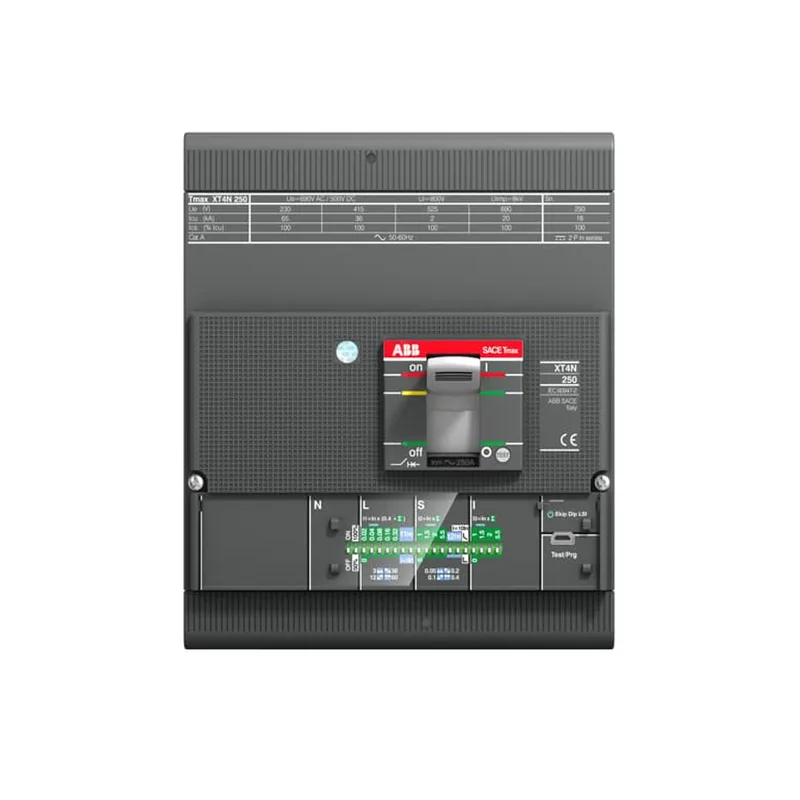
Frame rating vs trip setting — why both numbers matter
The 1SDA068158R1 is an ABB XT4N 160 breaker with a 40 A Ekip LSIG trip unit plugged into a 160 A frame. The Iu (160 A) is the maximum continuous current the breaker body and terminals can carry; the In (40 A) is the installed protection setting. This means the same breaker shell can be re-trip'd up to 160 A by swapping the electronic trip unit — useful if the load grows and you want to avoid pulling the whole breaker. The Ekip LSIG trip provides L (long-time), S (short-time), I (instantaneous), and G (ground-fault) protection curves. The G function is the differentiator here — it detects leakage currents down to the trip unit's adjustable threshold, which matters for personnel protection on IT or TN-S systems where a standard LI or LSI breaker would miss a ground fault until it became a phase fault.
4-pole switching — when you need to break the neutral
Four poles means all three phases plus the neutral are switched and protected. This is mandatory in TN-S or TT distribution where the neutral is a current-carrying conductor that must be isolated for safe maintenance. It also simplifies coordination in dual-source transfer schemes where the neutral path must be broken to prevent circulating currents. Rated 690 V, so it covers 400 V and 480 V systems with headroom for voltage swells, and it's suitable for 690 V industrial grids common in mining, marine, and heavy process plants. The 50/60 Hz rating means it's at home on either side of the pond.
Sourcing and lifecycle — still a catalog item
Estimated lead time is 2-4 weeks, which is typical for a built-to-order MCCB. Not a stocked shelf item, but the lead time is standard for the class and predictable for project planning.