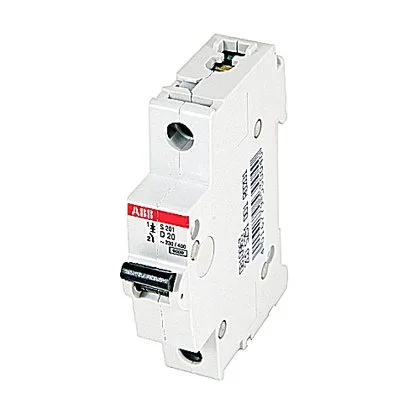
The ABB S201-D20 is a 1-pole miniature circuit breaker rated 20 A with a D trip curve, meaning it tolerates the high inrush currents typical of motor and transformer loads before tripping on sustained overload — the D curve's magnetic trip threshold sits around 10–20× rated current, so a motor starting surge won't nuisance-trip it the way a B or C curve would.
No rewiring or panel rework if you're swapping in a panel that already holds S200 breakers.
D curve vs C curve — the real difference
The closest functional peer is the S201M-C10, a 10 A C-curve single-pole in the same mechanical package. The D curve on this S201-D20 shifts the magnetic trip from 5–10× rated (C curve) to 10–20× rated, so it's the right choice when the load is a small motor, a transformer primary, or a bank of LED drivers that pull a short high inrush on energization. The C curve would nuisance-trip on that same inrush; the D curve holds through it. If your panel was specified around the S201M-C10 but the load changed to something with higher inrush, the S201-D20 drops into the same DIN-rail slot with the same wiring — no terminal adapter, no busbar change. The only difference is the trip characteristic and the amp rating (20 A vs 10 A), so verify the conductor sizing and downstream device coordination before swapping.
Torque to 2.8 Nm. The busbar comb slots into the bottom terminal for daisy-chaining multiple poles; leave the protective cover on the busbar fingers to maintain IP20 touch safety inside the panel. The 1-pole form factor means you can gang it with adjacent S200 breakers on a shared busbar for multi-pole configurations — two S201-D20s with a 2-pole busbar comb give you a 2-pole 20 A D-curve assembly, three give you 3-pole. The trip curves stay independent per pole, so a phase-to-phase fault clears on the affected pole only.