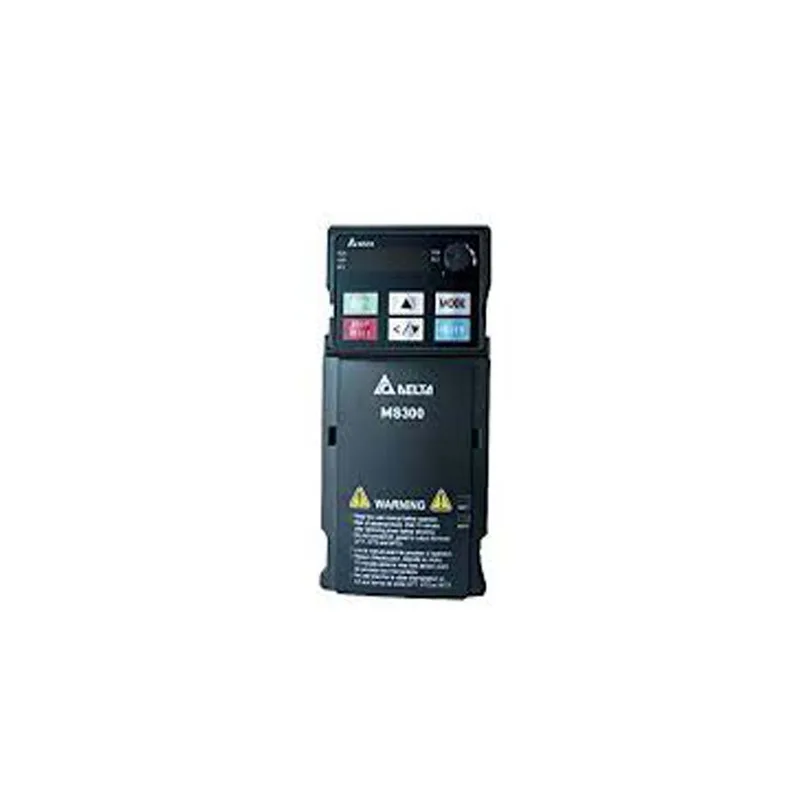
What this drive sits behind on the line
The Delta VFD2A8MH21ANSAA is a compact variable-frequency drive in the MH300-series class, sized at 0.4 kW (1/2 HP) — meaning it sits on small fractional-horsepower loads: conveyor idlers, small fans, metering pumps, lab mixers, the kind of stand-alone stations where a 240 V single-phase feed is what's on the wall and a 3-phase motor still has to spin off it. It's a single-phase 200–240 V input drive with a rated output capacity of 1.2 kVA at 3.2 A — i.e. a real-world ceiling of 3.2 A continuous to the motor before you start tripping into current-limit, regardless of what the nameplate kW suggests.
Duty ratings and what actually governs the motor lead
Delta publishes this drive two ways: Normal Duty at 8.3 A input and Heavy Duty at 7.3 A input. The 3.2 A output figure is the constant-of-the-piece — pick Normal Duty for fans and centrifugal pumps where the load curve is quadratic, Heavy Duty for conveyors, mixers, and any constant-torque load that pushes back at low speed. Mis-sizing the duty class is the single most common reason a drive of this rating trips on acceleration. Carrier frequency is adjustable from 2 to 15 kHz with a 4 kHz factory default — push it to 8 kHz or above to silence motor whine, but expect the continuous output current to step down because the IGBTs are switching harder. Leave the default unless the acoustic noise is the actual complaint, not a number on a sheet. In a fully packed enclosure with no fan assist, the ambient derating kicks in earlier than on a force-cooled unit of the same rating.
Input supply, EMC, and panel-side wiring reality
The unit ships with the EMC filter as optional, so if the panel ends up near a PLC rack or behind a sensitive instrument loop, the filter module needs to land in the BOM separately. IP20 means finger-safe at the panel face but not sealed — this is a cabinet-mount drive, not a washdown or field-side unit. The Frame A footprint keeps it on the small-end of the MH300 lineup, which matters when the wall space inside the enclosure is the binding constraint, not the motor list.
Lifecycle status and how it's sourced
Lifecycle is recorded as current with a typical lead time of 1 to 10 working days. For a BOM line that calls for this exact code, that's a quoted-to-order posture through independent distribution — no price or stock figure on the page; availability and the volume quote land at RFQ. If a PCN lands later, the cross-reference will normally stay inside the same MH300 single-phase 200–240 V family — but until Delta publishes a successor part number, treat the spec as stable and the supply chain as the only moving variable.