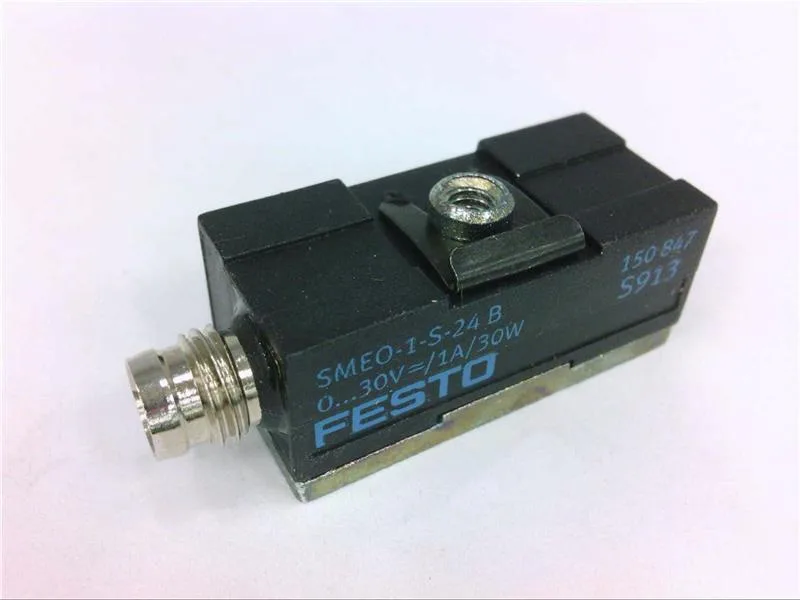
The Festo SMEO-1-S-24-B is a B-series magnetic reed proximity sensor — the kind that detects the piston position in pneumatic cylinders via a magnetic field. It's a contacting, bipolar N/O switch, so the reed closes when the magnet passes, and it handles both AC and DC loads without polarity concerns. The 27 W maximum switching capacity at up to 1000 mA means it can drive a small relay coil or a PLC input directly, no interposing amplifier needed. The IP67 rating tells you the housing and the M8x1 3-pin connector survive washdown and coolant spray — common on packaging and assembly lines where sensors get hosed off.
This sensor slides into the T-slot of Festo cylinder profiles — the SMEO-1 body is sized for standard C-slot and T-slot grooves. The 34 x 15.7 x 23 mm footprint fits flush into the slot, and the M8x1 plug lets you replace a failed sensor without pulling new cable through the track. Ambient range of -25 to +70 °C covers unheated plant floors and cabinets near ovens, but watch the upper end if the cylinder is close to a heat source.
Signal integrity and repeatability
The ±0.1 mm reproducibility is tight for a reed sensor — you get consistent switching point cycle-to-cycle, which matters for end-of-stroke confirmation on pick-and-place or clamping operations. The contacting nature means there's no leakage current when open, unlike solid-state proximity switches, so a PLC input sees a clean dry contact. If the signal looks jittery, check the shield on the M8 cable first — reed sensors are passive, so any noise coupled into the pair shows up at the input card.
The SMEO-1-S-LED-24-B is electrically identical — same 24 VDC nominal, same 1 A / 27 W switching capacity, same M8 connector and IP67 rating. The difference is the LED status indicator on the LED variant. If your panel has a local HMI or the cylinder is visible during cycling, the LED saves a meter check. If the sensor is buried in a cable tray or inside a machine guard, the non-LED SMEO-1-S-24-B is the same part without the visual feedback — and one less LED to fail in high-vibration applications.