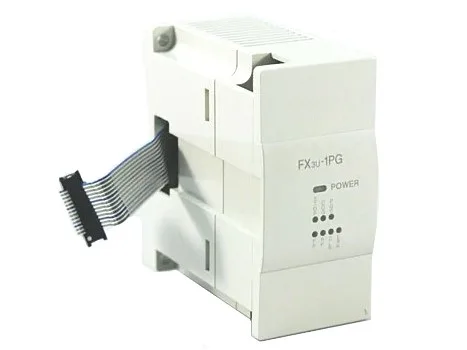
Pulse output ceiling and what it buys you
The FX3U-1PG delivers a 1 Hz to 200 kHz output frequency range, which covers the vast majority of stepper and servo pulse-train inputs used in FX3U-based positioning applications. At 200 kHz, a typical 1,000-pulse/rev stepper drive runs at 12,000 rpm — well past the motor's torque curve, so the practical ceiling is the drive, not the module. Output format is NPN open collector transistor, so it sinks current to ground on each pulse. The load side — typically a stepper drive or servo amplifier — must provide the pull-up voltage (DC 5 to 24 V) and limit the ON current to 4.0 mA or more per the spec.
Positioning units and range — fit for the axis type
The module works in PLS (pulses), µm, 10⁻⁴ inch, or mdeg, with a range of -2,147,483,648 to 2,147,483,647 PLS. That 32-bit signed range gives ±2.1 billion counts — enough for a multi-revolution absolute axis with sub-micron resolution. Positioning method supports both incremental and absolute, selected per program. The unit magnification (1, 10, 100, 1000×) lets you scale the command unit to match the mechanical system without rewriting the ladder logic.
Signal set for home return and interrupt positioning
The FX3U-1PG carries dedicated DOG (proximity dog) and STOP inputs for machine home return and deceleration-stop operations. DOG input response time is 1 ms; STOP input is 4 ms — fast enough for most mechanical systems where the start-up time is 1 ms (motor) to 2 ms (mechanical). A CLR signal output clears the deviation counter on the servo drive at the home position, and a PG0 zero-point signal input synchronises with the encoder Z-phase for repeatable homing.
Sourced to order against the BOM quantity through independent distribution.