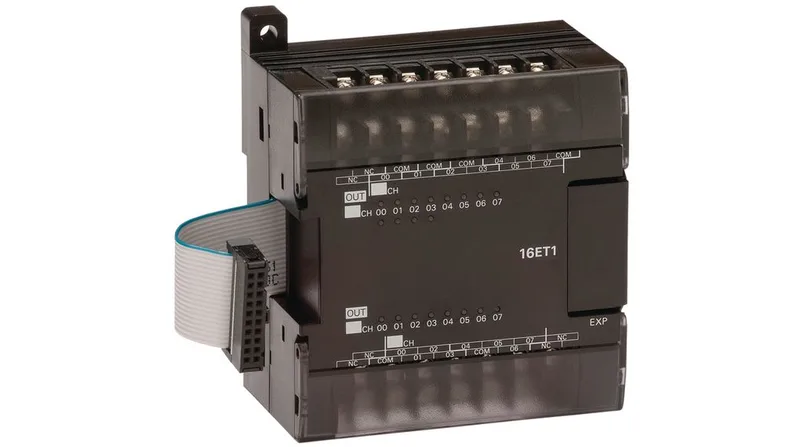
What it is and what it does
The CP1W16ET1.1 is a digital expansion module — a 16-point transistor output slice that mounts onto a CP-series host rack to lift the CPU's output count without replacing the PLC. Transistor outputs make it the right call for high-cycle, low-power DC loads — solenoid valves, indicator lamps, small relay coils, stepper pulse / direction lines — rather than anything on the mains side, where a relay or triac output module would be specified instead. The DC operating window is 5 V to 24 V, so the same module drives a 5 V logic rail or a 24 VDC field bus; in practice almost every CP1W16ET1.1 in the field runs on the panel's 24 VDC supply.
Termination and panel-side wiring
Outputs land on screw terminals, so the panel builder is working with a standard ferrule and a familiar torque pattern rather than a spring-cage or MIL connector — strip length and ferrule size match typical Omron CP-series practice. Because this is a transistor (solid-state) output stage, a free-wheeling diode is not required at the module itself, but inductive DC loads downstream still want a flyback diode or TVS across the coil for long contactor life.
Where it does not drop in
The CPM1A-10CDR-A is similarly out of class: a stand-alone 10-point AC-powered micro-PLC (6 inputs / 4 relay outputs) in its own 57 × 92 × 38 mm housing, not a CP-series expansion module. Useful as the prior generation Omron micro-PLC the CP1W family replaced, not as a swap for this module.