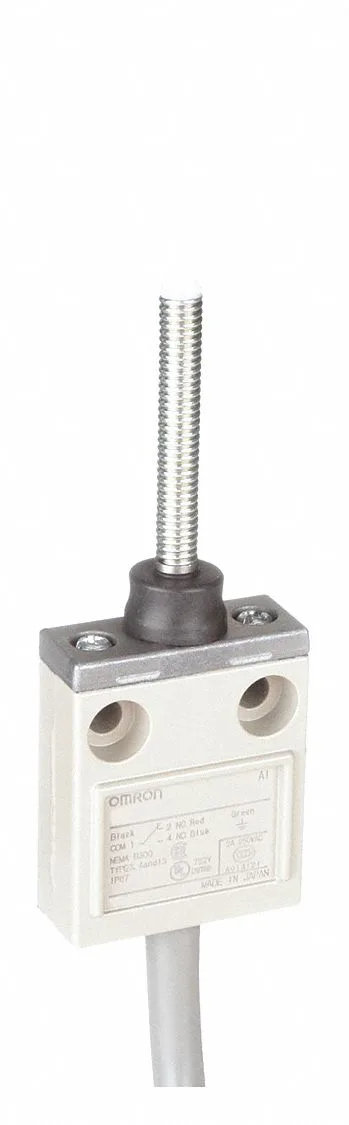
The Omron D4C1650 is a rod-actuated limit switch from the D4C series, built for position sensing in industrial environments where a physical mechanical stop signals a change in state. The SPDT contact form gives you both a normally-open and normally-closed set of contacts in one package, so you can wire it for both a status signal and a safety interlock from a single device. The IP67 rating means the switch body is dust-tight and protected against temporary immersion in water — suitable for washdown areas, outdoor installations, or anywhere coolant and chips are present. The NEMA 3, 4, and 13 ratings back this up for North American specifiers: NEMA 3 covers outdoor rain and sleet, NEMA 4 adds hose-down, and NEMA 13 includes oil and coolant spray. Contact ratings are 5 A at 250 V AC and 4 A at 30 V DC. The AC figure governs most control-circuit and pilot-duty applications; the DC rating is lower because DC arcs are harder to extinguish — factor that into any solenoid or DC coil load you switch directly. The momentary action means the contacts return to their resting state as soon as the rod is released, which is the standard behavior for a limit switch used as an interlock or position sensor.
The switch mounts to a surface via two 0.2-inch diameter holes on a 25 mm square pattern — a common footprint for panel and machine builders. The aluminum body measures 1.57 in wide by 0.62 in deep by 1.92 in tall, with the rod actuator extending 3.15 in above the top. Overall height with the rod is 6.02 in, so plan for clearance above the mounting surface. The rod actuator is omnidirectional, meaning it can be approached from any horizontal angle, and the pretravel and total travel are both 15° — a short, crisp actuation angle that gives repeatable trip points. Differential travel is 0.01 in, so the switch resets with very little hysteresis; good for applications where you need the signal to drop out close to the same position it picked up. Operating force is 1.47 N maximum — light enough that a cam or lever arm won't need heavy spring loading, but firm enough to resist false trips from vibration. Temperature range is 14 °F to 158 °F (-10 °C to 70 °C), covering most indoor industrial environments and conditioned outdoor enclosures.
The switch carries UL Listing, CSA, CE, CCC, and EN standards — covering North American, European, and Chinese regulatory jurisdictions. This simplifies compliance for machinery shipped to multiple regions; the UL and CSA marks are particularly important for panel builders who need a UL 508A-listed component in the BOM.