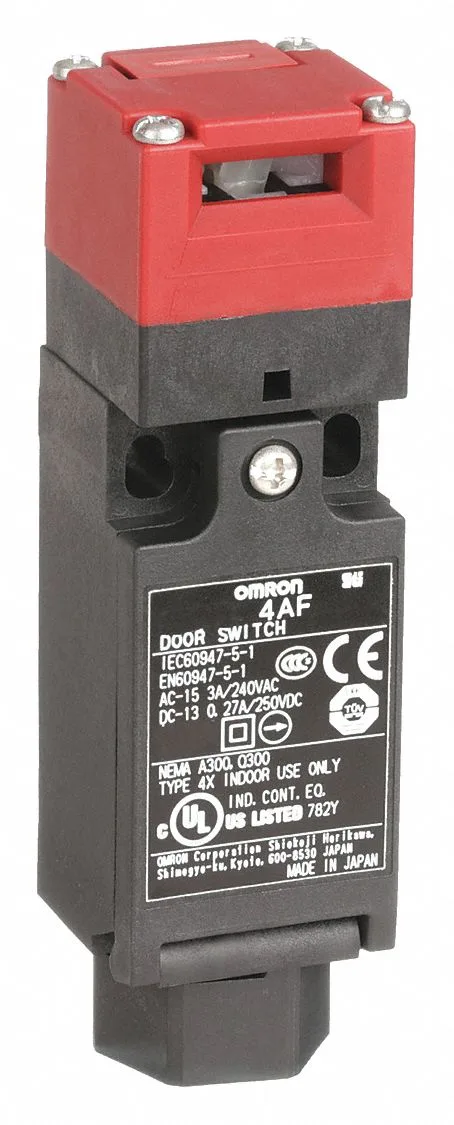
Safety interlock for guarded zones
The Omron D4NS-4AF-NPT is a safety interlock switch from the D4NS series, designed to monitor the position of movable guards on machinery. It uses a separate actuating key (not included) to positively open the NC contact when the guard is opened, meeting the requirements of safety circuits up to SIL 3 / PL e depending on the system architecture. The 1NO/1NC contact configuration provides one channel for the safety chain and one for a status signal to the PLC. Rated for 10 A at 600 V AC and 2.5 A at 250 V DC, the switch handles both motor control and signal-level loads. The gold-plated contacts are significant here: they allow reliable switching of low-voltage, low-current signals (e.g., 24 VDC PLC inputs) where standard silver contacts would oxidize and fail to conduct. This makes the D4NS-4AF-NPT suitable for mixed-load applications where the same switch feeds both a contactor coil and a safety input card.
Where it fits — panel and environment
The switch body is polyamide with a plastic flat actuating key, giving it a compact footprint: 1.22 in wide, 1.18 in high, 3.78 in deep (–). The M20 threaded conduit entry accepts standard metric glands, and the front key-hole location allows straightforward alignment on sliding or hinged guards. Pre-travel is 10 +/-5 mm, over-travel 10 mm, and positive travel 20 mm — these define the guard position tolerance before the NC contact opens. IP67 and NEMA 6 ratings mean the switch withstands temporary immersion and hose-down cleaning — common in food, beverage, and washdown environments. The operating range is -22 °F to 158 °F (–), covering most indoor industrial settings. For hazardous locations, the switch carries Class I, Division 2, Groups A, B, C, D approval, allowing installation in areas where flammable gases or vapors may be present under abnormal conditions.
Mechanical operating durability is rated at 1,000,000 cycles, which sets the expected service life under normal actuation. The slow-action circuitry ensures positive contact opening independent of actuation speed — a requirement for safety-rated guard interlocking per IEC 60947-5-1.