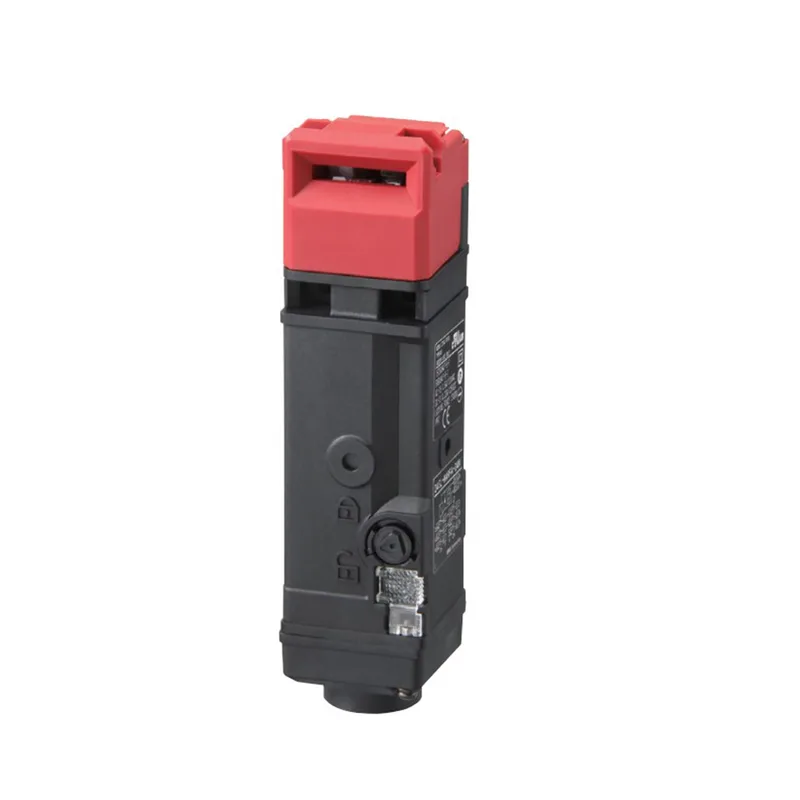
The D4SL-N2HDA-D4 is a Guard Lock Safety-door Switch from Omron's D4SL series — a solenoid-locking safety interlock designed to prevent access to a guarded area until the machine control has removed power or motion. The mechanical lock holds the door closed; the 24VDC solenoid releases it only when the safety circuit permits. This is the variant with a metal head (D), a G1/2 conduit outlet (2), and a built-in switch configuration of 3NC + 2NC contacts (H). The 24VDC solenoid release is monitored by an orange LED indicator on the switch body, giving a quick visual check that the solenoid is powered and the lock is released. The special release key (resin) allows manual override in a fault condition — useful for freeing trapped personnel without power. Connection is via a terminal block inside the switch body, with a G1/2 conduit entry for the cable gland. The metal head gives better impact resistance than resin-head variants, so this is the one to specify for heavy industrial doors or where the switch might take a knock.
Switch contact configuration — what 3NC + 2NC means for your safety circuit
The built-in switch has five contact blocks: three normally-closed (NC) and two normally-closed (NC). That is a lot of NC contacts for a guard switch. In a typical safety circuit, the NC contacts are wired in series to the safety relay or PLC safety input — all must be closed (door locked) for the machine to run. The 3NC + 2NC arrangement gives you five independent channels to monitor the door lock position. This is more than the usual 2NC or 3NC found on basic interlocks; it allows for dual-channel monitoring plus a feedback loop, or for wiring through multiple safety zones without adding extra contact blocks. Compared to a standard 2NC + 1NC guard switch, the D4SL-N2HDA-D4's extra NC contacts give you redundancy and diagnostic coverage without needing an external expansion module. If you are designing to SIL 3 or PL e, the additional contacts simplify the architecture — you can dedicate one NC pair to the safety relay and another to the PLC for status monitoring, all within the same switch.