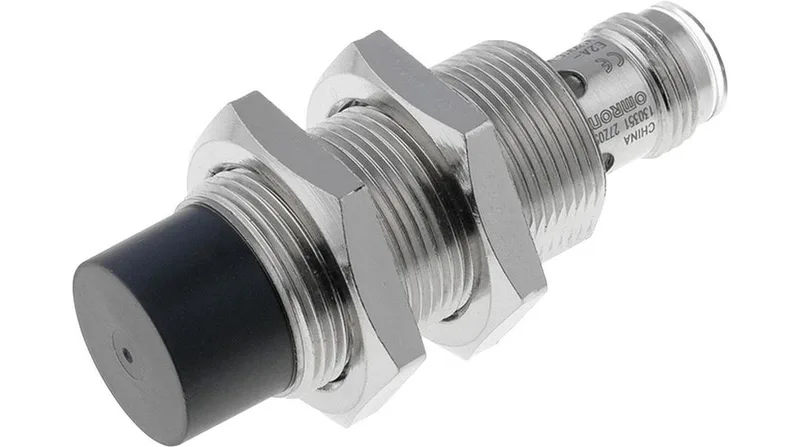
The Omron E2AS18KN16M1B1 is an M18 inductive proximity sensor from the E2A series, delivering a 16 mm sensing distance in non-flush mounting. It switches a normally-open (NO) contact when a metal target enters range, rated for loads up to 200 mA across the 10–32 V supply band. The stainless-steel housing and IP67/IP69K protection make it suitable for washdown environments, food processing, or pharmaceutical fill suites where high-pressure cleaning cycles are routine.
The 16 mm sensing distance applies to mild steel targets under standard conditions; derate for non-ferrous metals or when the sensing face is shielded by adjacent steel. Repeat accuracy is 10%. The NO output transitions when a metal target enters the field; with no target present the output is open. Its 200 mA continuous load capacity drives small contactors, PLC inputs, or relays directly. Current consumption of 10 mA from the supply is negligible for most power budgets. M12 4-pin connector mates to standard industrial cordsets. The 24 mm wide by 24 mm high by 53 mm long body is a compact M18 barrel format — check gland-plate clearance if retrofitting into an existing panel cutout.
The E3SAT36 is a photoelectric with 7 m sensing range, requiring a reflective target and offering PNP light/dark-on switching. The E2AS18KN16M1B1 is inductive — it only detects metal targets at 16 mm — so it is not a direct electrical or mechanical swap. A panel originally built for the E3SAT36 would need rewiring (NO vs PNP) and different mounting. If your application strictly calls for metal presence in a compact machine cell, the inductive sensor may serve the same functional role without a reflector, but verify output type and sensing distance ahead of any BOM change.