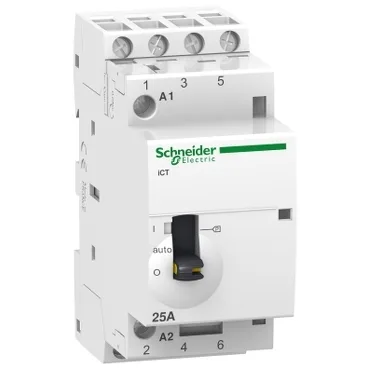
It clips onto a 35 mm symmetrical DIN rail and fits a 36 mm wide footprint (4 module pitches). Rated operational current is 25 A in AC-7A duty (resistive/motor loads) and 8.5 A in AC-7B (motor loads with intermittent duty), at 400 V AC 50 Hz. The control coil takes 220-240 V AC 50 Hz, drawing 34 VA inrush and 1.6 W holding at rated voltage. Electrical durability is rated at 100,000 cycles under AC-7A at 25 A, and 30,000 cycles under AC-7B at 8.5 A. Mechanical durability hits 1,000,000 cycles, so it's built for years of daily switching in a lighting panel or small motor starter.
The 25 A AC-7A rating covers resistive/heater loads. The 8.5 A AC-7B rating is the limit for motor loads with intermittent duty. The 4 NO pole configuration means all four poles are normally open — no built-in auxiliary NC. If you need a feedback signal, you'll add an external auxiliary contact block.
Compliance is to IEC/EN 61095 (household and similar electromechanical contactors) and EN 60947-4-1 (low-voltage switchgear for motor starters).
The 36 mm width (4 module pitches) means it takes up four slots on a DIN rail; plan your enclosure fill accordingly. Terminal torque is 0.8 N.m for both control and power circuits — a standard screwdriver setting, no special tooling. Wire sizes: power circuit accepts 1 to 4 mm² flexible or 1.5 to 6 mm² rigid; control circuit takes 1.5 to 2.5 mm² rigid or flexible (up to 2 cables). Tunnel-type terminals, so strip and insert — no bootlace ferrules required but recommended for flexible wire. Depth is 60 mm, height 81 mm — fits most standard enclosures.