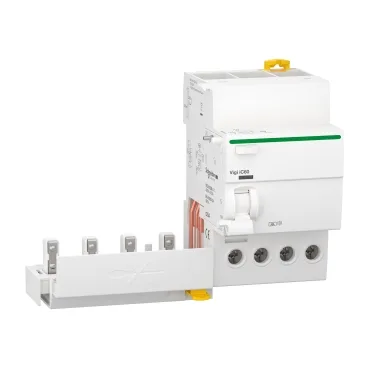
It is a 4-pole (4P) unit rated at 25 A with 500 mA sensitivity and instantaneous trip, designed for 230-415 V AC 50/60 Hz networks. The clip-on mounting and 6 x 9 mm pitch footprint let it snap directly onto a DIN rail alongside the breaker, occupying 54 mm of width in the panel.
The 500 mA sensitivity and Type A waveform detection mean this RCD catches sinusoidal AC faults plus pulsating DC residual currents — the kind produced by single-phase rectifiers in switched-mode power supplies or variable-speed drives. It is voltage-independent, so it trips on leakage current even if the line voltage collapses, which matters for outgoer circuits where a lost neutral could otherwise mask a ground fault. The instantaneous trip (no intentional delay) coordinates with downstream devices but requires selectivity checks upstream: a 500 mA instantaneous RCD will trip before a 300 mA time-delayed unit if both see the same fault. Rated operational voltage spans 230-415 V AC, covering both single-phase and three-phase line-to-line configurations on a 4-pole device.
Integration and wiring constraints
The A9Q26425 is an add-on module that plugs into the right side of an iC60 MCB — it is not a standalone RCD and requires the breaker for overcurrent protection. Bottom tunnel terminals accept 1-25 mm² rigid or 1-16 mm² flexible conductors (with or without ferrules). The bottom connection also accepts comb busbars, simplifying distribution in multi-way panels. The device is positioned as an outgoer in the system, meaning it protects a final sub-circuit rather than a main incomer.