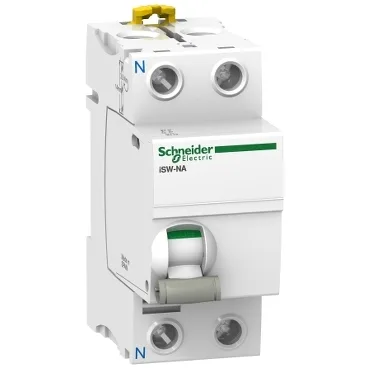
The Schneider Electric A9S70680 is a switch disconnector from the Acti9 iSW-NA series, rated 80 A at 230/240 V AC in utilisation category AC-22A per EN/IEC 60947-3. That AC-22A rating means it is designed for switching mixed resistive and inductive loads, including motor loads up to the rated current, with the isolation function certified — the contact position indicator and positive break confirm the circuit is physically open for safe maintenance. It occupies a 36 mm width (4 x 9 mm pitches) on a DIN rail, clip-on mounting, with a depth of 74 mm and height of 85 mm. The 1P+N configuration places the neutral on the left, switching both phase and neutral.
Electrical performance and fault handling
Rated insulation voltage (Ui) is 500 V AC, with an impulse withstand voltage (Uimp) of 6 kV — figures that confirm it can handle the voltage transients typical in industrial panels. The short-time withstand current (Icw) is 1.2 kA for 1 second, and the short-circuit making capacity (Icm) is 5 kA when used alone as a switch-disconnector. These ratings mean the device can close onto a fault and hold through a downstream short without welding its contacts, provided the upstream protection clears within the 1-second window. Electrical durability is rated at 15,000 cycles under load (AC-22A), mechanical durability at 20,000 cycles. The device is tropicalised (class 2) and operates from -35 °C to 70 °C ambient, with storage from -40 °C to 85 °C.
Clip-on DIN rail mounting with a 36 mm footprint — fits standard 35 mm DIN rails in any enclosure. The IP20 finger-safe protection is typical for panel-mounted switchgear; no special sealing required inside the cabinet. The white colour and local ON/OFF indication help with visual identification during commissioning and troubleshooting. Compliant with EN 60947-3 and IEC 60947-3, with suitability for isolation confirmed per those standards. The pollution degree 3 rating and tropicalisation class 2 indicate it is designed for long-term reliability in demanding environments — no special derating needed for typical industrial panel conditions.