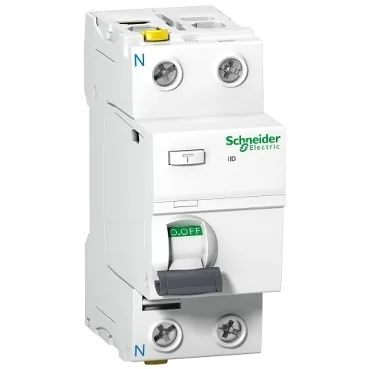
The A9Z11263: Rated operational voltage is 220...240 V AC at 50/60 Hz, which covers standard single-phase and split-phase mains in residential and light commercial panels across Europe, Asia, and Africa. Breaking and making capacity is rated at Idm 1500 A and Im 1500 A. In practice, this means the RCCB must be backed by an upstream overcurrent protective device (MCB or fuse) rated to break higher fault currents; the RCCB handles the earth-fault interruption, not the full short-circuit duty. The earth-leakage protection is instantaneous (no time delay) and voltage-independent — the tripping mechanism does not rely on the mains voltage to operate, so it remains functional even if the neutral is lost upstream. This is a safety-critical feature for RCCBs: a voltage-dependent design could fail to trip on a live-to-earth fault if the supply voltage collapses. Electrical durability is rated at 15,000 cycles under AC-1 (resistive load) conditions, with mechanical durability at 20,000 cycles. For a distribution board RCCB, this is a solid service life — the mechanical endurance typically governs in normal use since the device only operates on fault or test, not on every load cycle.
The A9Z11263 clips onto a standard 35 mm DIN rail (EN 60715) and occupies 4 modules of 9 mm pitch (36 mm total width). Neutral is on the left, which is the standard Acti9 busbar orientation. The toggle control and contact position indicator give a clear visual of the contact state — useful for lockout/tagout during panel maintenance.