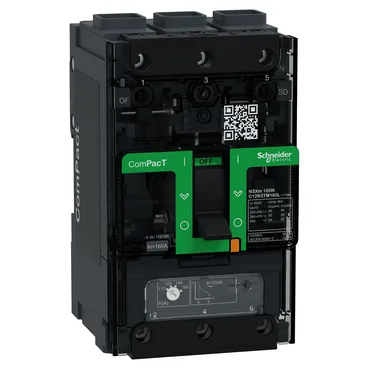
The C12N3TM160L is a Schneider Electric ComPacT NSXm 160N moulded-case circuit breaker (MCCB) with a TM-D thermal-magnetic trip unit, rated 160 A at 40 °C and 50 kA breaking capacity at 415 V AC. The 50 kA at 415 V AC is the short-circuit breaking capacity (Icu) per IEC 60947-2; it means this breaker can safely interrupt a fault current up to 50,000 A without welding or rupturing, which covers most industrial distribution panels fed by a 1 MVA transformer or smaller.
Front-connect terminals on both line and load sides, with Everlink lugs accepting 2.5 to 70 mm² flexible copper or up to 95 mm² rigid/stranded. The 35 mm connection pitch with spreaders (27 mm without) matters when laying out busbar or cable runs — plan the gland plate and fill factor accordingly. IP40 front face (protected against tools and small wires, not washdown) and IK07 impact resistance (2 Joules — survives a dropped screwdriver but not a hammer strike). Overvoltage category III (distribution level, not incoming utility).
What the TM-D trip unit means for protection coordination
The TM-D trip unit is thermal-magnetic: the thermal element (bimetal) handles overload protection with an inverse-time curve (longer delay at lower overcurrents), and the magnetic element (solenoid) provides instantaneous short-circuit protection above a fixed threshold. For the 160 A frame, the magnetic pickup is typically around 10× In (1600 A), which means it clears hard faults fast but lets motor inrush (typically 6–8× FLA for a few cycles) pass without nuisance tripping. The 13.7 W power dissipation per pole (41 W total for 3 poles at rated current) adds up in a sealed enclosure — check the thermal budget if the panel has multiple breakers side by side. Electrical durability is 20,000 cycles at 440 V at rated current, halved to 10,000 cycles at 2× In — fine for infrequent switching (distribution duty), not for daily motor starting.