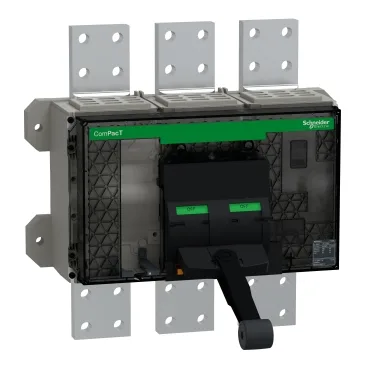
The C250N3FM is a basic frame — no trip unit, no protection — for the ComPacT NS2500N range. Rated 2500 A at 50 °C, it is sized for the main incoming feeder or a high-current bus riser in a distribution board. The frame carries IEC 60947-2 Category B and overvoltage category III, so it is rated for fixed-installation distribution, not motor starting. The 3-pole fixed backplate mount with 70 mm connection pitch bolts into a switchboard, not a DIN rail. At 420 mm wide × 360 mm high × 160 mm deep, it needs a dedicated compartment — plan the gland plate and busbar droppers around that footprint.
Because it is a basic frame without a trip unit, the buyer must specify a compatible Micrologic control unit separately. That is the part that sets the protection curve (LSIG, LSI, electronic or solid-state). If your BOM calls out the complete breaker assembly, confirm the trip unit order code alongside this frame — the C250N3FM alone is just the mechanical shell and main contacts.
For a 2500 A frame, that is a standard-duty rating — adequate for most industrial and commercial service entrances where the fault level is under 70 kA. If the site has a higher available fault current (e.g., close to a large transformer), step up to the H or L breaking capacity variants in the same NS2500 family. The Icw of 32 kA for 3 seconds governs how long the frame can carry a short-circuit current while the upstream protection clears — relevant for selective coordination studies.
Mechanical durability is 5000 cycles; electrical durability varies by voltage and current, with 1000 cycles at rated current on 690 V and 3000 cycles at half-rated current on 440 V. That is not a high-cycle switching device — it is a distribution breaker meant to stay closed and open only for isolation or fault clearing.