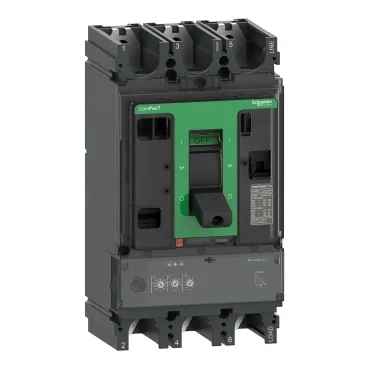
What this 400 A ComPacT NSX breaker delivers
The C40W32D400 is a Schneider Electric ComPacT NSX400HB2 molded-case circuit breaker rated 400 A at 40 °C with a MicroLogic 2.3 electronic trip unit. It breaks up to 100 kA Icu at 500 V AC, 525 V AC, and 660/690 V AC 50/60 Hz per IEC 60947-2 — that is full-rated interrupting capacity across the common industrial voltage bands, so you do not have to derate the breaker when the line voltage drifts up from 480 to 525 V or lands on a 690 V corner-grounded delta. The 3-pole form factor (140 mm wide, 255 mm tall, 110 mm deep) mounts on a backplate in horizontal or vertical orientation, and the front-face toggle gives the operator a visible, positive break for lockout-tagout. The IP40 front face keeps tools and fingers out of live parts; the IK07 impact rating handles the occasional dropped screwdriver or panel door slam.
Because this is an active, high-volume catalog item, lead times are typically standard for the class — the procurement decision is whether the 400 A rating and 100 kA breaking capacity match your fault-current study, not whether you can get the part.
Integration and mounting notes
The 45 mm connection pitch lines up with standard busbar systems and cable lug spacing. Six accessory slots are available for auxiliary contacts, alarm switches, shunt trips, or under-voltage releases. Plan the slot allocation before wiring — the toggle handle and LED indicators (green for ready, red at 105 % Ir overload, orange at 90 % Ir pre-alarm) are visible through the front cover, so the operator gets a quick status check without opening the panel door. Electrical durability is rated at 12,000 cycles at 440 V In/2 and 6,000 cycles at 440 V In; mechanical durability is 15,000 cycles. For a distribution breaker that sees infrequent switching, that is effectively a lifetime rating. If the breaker is used for daily motor switching, the electrical endurance at 690 V (3,000 cycles at In/2, 6,000 at In) becomes the limiting factor — plan for replacement earlier in that duty cycle.
The suitability-for-isolation marking (yes, per EN/IEC 60947-2) means the breaker can serve as a visible disconnect point in the circuit — no separate disconnect switch needed upstream for many installations. Operating altitude is 0 to 2000 m without derating; above 2000 m up to 5000 m, derate the continuous current per the manufacturer's altitude correction factors.