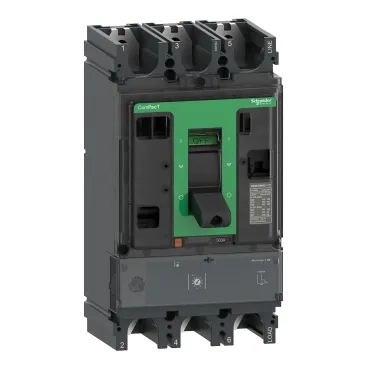
The C63N31M500 is a Schneider Electric ComPacT NSX630N moulded-case circuit breaker in the ComPacT NSX range, sized for motor protection duty with a 500 A electronic trip unit (MicroLogic 1.3 M) rated at 65 °C. The electronic trip gives you adjustable short-time and instantaneous protection curves, which matters when you're coordinating downstream starters or VFDs and need to ride through inrush without nuisance trips.
Breaking capacity across your voltage levels
The Icu (ultimate breaking capacity) varies with system voltage, which is typical for MCCBs. At 240 V AC it's rated 85 kA, at 415 V it's 50 kA, at 440 V it's 42 kA, at 500 V it's 30 kA, at 525 V it's 22 kA, and at 690 V it holds 10 kA. That means in a 480 V panel (common in North American plants) you're looking at roughly 50 kA SCCR headroom if the assembly is listed to UL 60947-4-1. For European 400 V networks, the 50 kA figure covers most transformer-fed buswork.
The breaker measures 255 mm high by 140 mm wide by 110 mm deep, mounts flat on a backplate in either horizontal or vertical orientation. Front connections top and bottom — no rear-access bus required, which simplifies gland-plate layout in a standard enclosure. Six accessory slots on the front for shunt trips, aux contacts, or alarms — enough for a full complement of status feedback to a PLC.
Durability and thermal handling
Mechanical endurance is 15,000 cycles; electrical endurance at full rated current (440 V In) is 4,000 cycles, and at half current it doubles to 8,000 cycles. That's typical for a 500 A frame — plenty for a motor centre where the breaker cycles maybe a few hundred times a year. Power dissipation is 25 W per pole, so 75 W total for the 3-pole unit at full load. That heat needs to be vented or factored into the enclosure's thermal budget; don't stack it tight against other high-dissipation gear without a derating check.