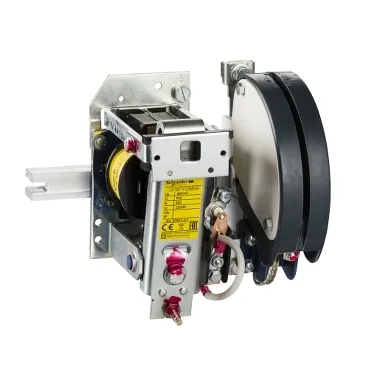
The Schneider Electric TeSys B contactor CV1BF0Z1FMD00 is a DC-coil, single-pole normally-closed (1 NC) switching device rated for 80 A in both AC-1 and AC-3 utilisation categories. The 80 A figure is the conventional free-air thermal current (Ith) at 40 °C, which also matches the rated operational current (Ie) for the control circuit — so the contactor carries its full rating without derating in open panel air. At 400 V AC, AC-3 duty, it handles a 37 kW motor load; that is the headline selection number for a three-phase induction motor on a conveyor, pump, or fan. The 220 V DC coil means it is intended for a DC control bus — common in 220 VDC substation or industrial DC distribution schemes — and the control circuit voltage limits (0.85 to 1.1 Uc for pickup, 0.1 to 0.65 Uc for dropout at 55 °C) define the reliable operating window: the coil will pull in at 187 V DC minimum and drop out below 143 V DC.
Where it is used and how it integrates
This contactor belongs to the TeSys B series, designed for motor starting and resistive load switching in control panels. The IP00 protection rating means it is intended for enclosure mounting — it has no integral housing and must be installed inside a panel that provides the environmental seal. The single NC pole is the normally-closed main contact; this is unusual for a power contactor (most are normally-open) and is specified for applications where the load must be connected when the coil is de-energised — for example, a bypass circuit or a fail-closed valve. Power connections are bolted, sized for cable lugs up to 25 mm² or connector up to 16 mm², with a tightening torque of 9 N.m. The control circuit accepts wire up to 25 mm² on a single lug or 2 x 16 mm² on a connector.
The rated short-time withstand current (Icw) is 640 A for 5 seconds at 40 °C — this is the fault current the contactor can carry momentarily without welding its contacts, relevant for coordination with upstream fuses or breakers. The associated fuse recommendation is 80 A aM or 125 A g1 at up to 400 V for the control circuit. Mechanical durability is 5 million cycles; the maximum operating rate is 120 cycles per minute at 55 °C. Power dissipation per pole is 7.6 W in AC-3 and 9.6 W in AC-1 — useful for thermal calculations inside a sealed enclosure.