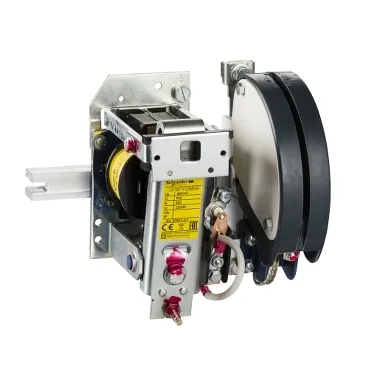
It switches resistive and motor loads (utilisation categories AC-1 and AC-3) per IEC 60947-4 and EN 60947-4, so it handles both heating/lighting circuits and motor starting within the same panel. Power dissipation runs 7.6 W per pole in AC-3 duty, 9.6 W in AC-1 — factor that into enclosure heat rise if the panel is tight.
The DC-operated coil pulls in at 0.85 to 1.1 Uc and drops out between 0.1 and 0.65 Uc below 55 °C. Hold-in power consumption is 20 to 27 W. Operating time is 130 ms closing, 30 ms opening — fast enough for most sequencing, but if your safety circuit demands a quicker drop-out, verify the break time against your stop category. Control circuit terminals accept cable with lug up to 25 mm² or connector up to 16 mm²; tighten to 1.2 N·m. Power circuit terminals take 25 mm² lug or 16 mm² connector at 9 N·m.
Vibration resistance is 4 gn (2 gn in some axes), shock resistance 4 gn / 2 gn — fine for most industrial panels but check if the machine sees repetitive hammering. Mechanical durability is rated at 5 million cycles. Maximum operating rate is 120 cycles per minute at 55 °C. For high-duty-cycle applications (frequent jogging or reversing), derate or step up to a larger frame.