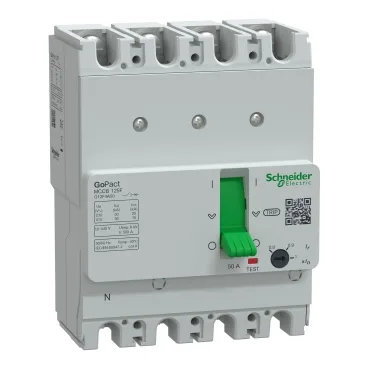
The Schneider Electric G12F4A50 is a GoPact MCCB 125 4-pole molded case circuit breaker rated 50 A at 40 °C, with a TM-D thermal-magnetic trip unit providing LI protection (overload and short-circuit). It's built for distribution duty in fixed-mount, backplate installations, with front-facing screw terminals and a toggle actuator.
The TM-D trip unit gives a fixed thermal curve for overloads and a fixed magnetic pickup for shorts; no adjustment dials, so selectivity with downstream devices depends on the inherent band separation. Category A utilisation means it's not intended for current-limiting duty on high-energy faults — it's a distribution breaker, not a motor-circuit protector. The 440 V AC insulation voltage and 415 V AC operational voltage match standard 400 V class three-phase networks. Suitability for isolation per EN/IEC 60947-2 means you can safely use it as a visible-break disconnect for lockout-tagout — the open contacts meet the creepage and gap requirements for an isolating function.
Fixed mount on a backplate — no DIN-rail adapter, so plan for drilled and tapped mounting points or a dedicated breaker panel. The 100 mm width, 130 mm height, and 60 mm depth (4-pole form factor) fit standard MCCB cutouts; the 25 mm connection pitch matches common busbar and terminal-block spacing. Neutral is on the left in the 4-pole arrangement, with 4D protected poles meaning all four poles (including neutral) are switched and protected.
Endurance and thermal budget
Mechanical durability of 30,000 cycles and electrical durability of 8,000 cycles at 415 V In — that's the expected life under rated load switching. For a distribution breaker that sees infrequent manual switching and rare fault interruptions, this is ample. The 18.7 W power dissipation per pole means the 4-pole unit dumps about 75 W into the enclosure at full rated current; factor that into your panel thermal calculation to avoid nuisance tripping from internal heat rise.
These are the core IEC standards for low-voltage switchgear and controlgear — the Annex H compliance means the manufacturer has verified coordination characteristics with specific upstream devices, which simplifies selectivity studies.