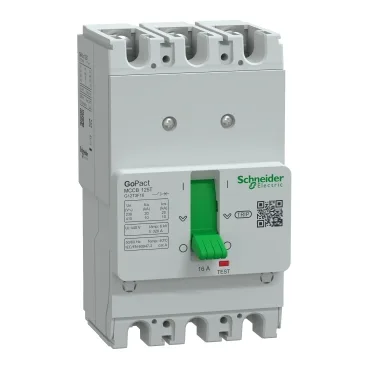
It carries a 10 kA breaking capacity at 415 V AC (50/60 Hz) per IEC 60947-2, so it handles fault currents up to that level without upstream escalation in a panelboard or sub-distribution board. The TM-D trip gives you LI protection: thermal for overload (L), magnetic for short-circuit (I).
That holds for coordination with downstream MCBs in a selective scheme — verify the let-through energy against your branch breaker's withstand. Overvoltage category III suits fixed-installation distribution boards. Mounts fixed to a backplate via screw terminals; connection pitch is 25 mm. Terminals are front-accessible both line and load side, which simplifies busbar or cable routing in a panel. IP20 means finger-safe but not sealed — keep it inside an enclosure rated for the environment.
Durability and environment
Electrical durability is 8000 cycles at rated current and voltage; mechanical durability is 30,000 cycles. That's standard for a distribution MCCB — not a motor-switching duty cycle (that would require AC-3 or AC-4 ratings). Power dissipation is 18.7 W per pole, so at full load the 3-pole unit dissipates about 56 W — factor that into panel thermal calculations. Altitude derating applies above 2000 m — no derating needed below that.