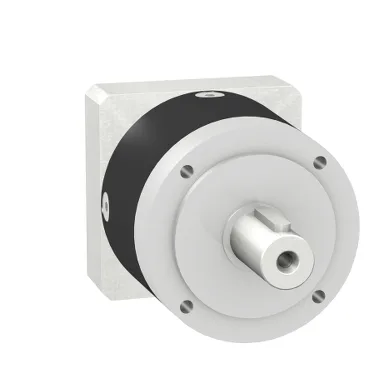
The GBX0600040583D is a 60 mm-diameter planetary gearbox with a 4:1 reduction ratio, delivering 38 N.m continuous output torque and a peak of 61 N.m. The 96 % efficiency means the power loss through the stage is low — for a 400 W servo motor, you lose about 16 W in the gearbox, which the anodised aluminium housing sinks without forced cooling in most panel-mount positions. The 20 arc-min maximum torsional backlash classifies this as a standard-precision gearbox — adequate for positioning conveyors, indexing tables, and pick-and-place gantries where the repeatability requirement is under 0.5 mm. For a 60 mm output shaft, 20 arc-min translates to roughly 0.17 mm tangential play at a 150 mm radius. Rated service life is 30,000 hours at 100 rpm and 30 °C ambient — that is about 3.4 years of continuous 24/7 operation. The axial and radial force limits drop sharply when you push beyond the 30,000-hour target: 450 N axial at 30,000 hours versus 600 N at 10,000 hours. For a belt-drive or rack-and-pinion load, the radial force at the shaft midpoint is the binding constraint.
Obsolete — sourcing through independent channels
Schneider Electric lists the GBX0600040583D as obsolete.
Mounting and integration notes
The gearbox mounts in any position — horizontal, vertical, or inverted — because it is lubricated for life with no oil-level dependency. The IP54 rating at the shaft output means it resists dust ingress and splashing water, but it is not rated for washdown or hose-down environments. The C 45 steel shaft handles the 61 N.m peak torque without yield, but the torsional rigidity of 2.3 N.m/arcmin means the shaft twists about 0.43° under full peak load — negligible for most positioning tasks but worth modelling if the load inertia is high and the cycle time is tight. The 0.093 g.cm² moment of inertia reflected to the motor side is very low — a 400 W servo with a rotor inertia around 100 g.cm² sees a 1:1 reflected load ratio at the 4:1 reduction, which keeps the servo tuning stable without a large inertia mismatch.